Germany’s Opportunity Card (Chancenkarte) and Work Visas: 2026 Guide
The Federal Republic of Germany operates one of the most structured and dynamically updated immigration systems within the European Union. Governed primarily by the Residence Act (Aufenthaltsgesetz) and the recently expanded Skilled Immigration Act (Fachkräfteeinwanderungsgesetz), the German framework seeks to actively mitigate structural labor shortages caused by demographic shifts. The adjudication of employment visas involves coordinated oversight by the Federal Foreign Office (Auswärtiges Amt), the Federal Employment Agency (Bundesagentur für Arbeit), and local Foreigners' Authorities (Ausländerbehörden). This guide details the primary statutory pathways for third-country nationals seeking employment in Germany for the 2026 fiscal year, highlighting the point-based Opportunity Card and traditional work permits.
The Opportunity Card (Chancenkarte): Point-Based Job Search
Historically, foreign nationals required a binding job offer to secure a German work visa. The implementation of the Opportunity Card (Chancenkarte) fundamentally altered this paradigm, introducing a point-based job search visa that allows third-country nationals to enter Germany for up to one year to secure employment or vocational training.
Basic Eligibility Prerequisites
To enter the point system, applicants must first satisfy mandatory baseline criteria. Failure to meet these foundational requirements renders the applicant ineligible, regardless of total points accumulated.
- Academic or Vocational Credential: The applicant must possess a university degree or a vocational qualification (requiring at least two years of formal training) that is fully recognized by the state in the country of origin.
- Language Proficiency: The applicant must demonstrate basic German language proficiency at the A1 level of the Common European Framework of Reference for Languages (CEFR), or advanced English proficiency at the B2 level, verified through recognized testing centers.
- Financial Solvency: The applicant must prove sufficient financial resources to sustain themselves for the duration of their stay in Germany without accessing public social welfare funds. For 2026, this is typically demonstrated via a blocked account (Sperrkonto) holding a statutory minimum monthly amount.
The Point Matrix
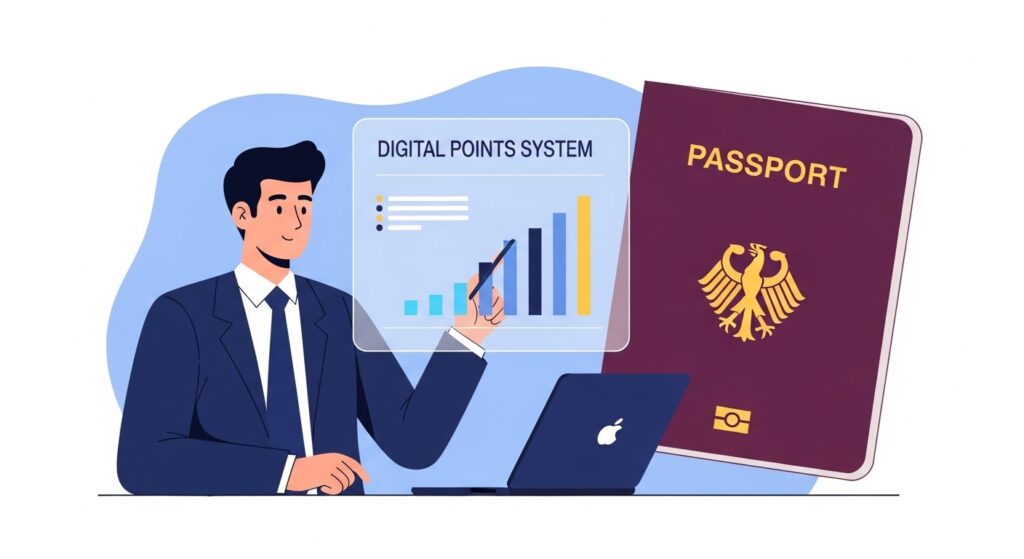
If the baseline criteria are met, applicants must score a minimum of six points across various categories to qualify for the Chancenkarte. Points are awarded based on:
- Professional Experience: Up to three points for verified professional experience in the applicant's field acquired within the last five to seven years.
- Language Skills: Additional points for German proficiency at the A2, B1, or B2 levels, or English proficiency at the C1 level.
- Age: Two points for applicants under the age of 35, and one point for those aged 35 to 40 at the time of application.
- Ties to Germany: Points are granted for prior lawful residence in Germany (excluding tourist stays) lasting at least six continuous months within the preceding five years.
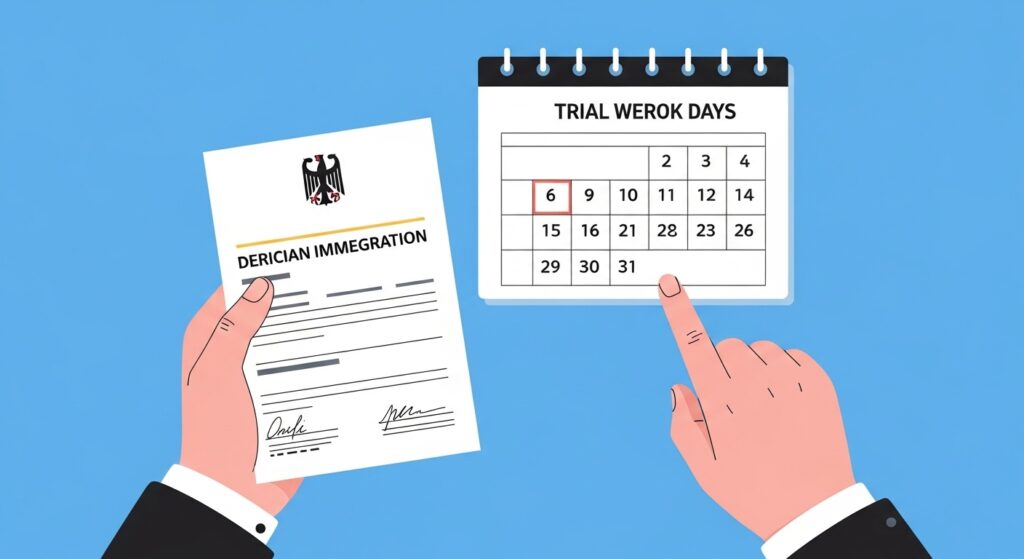
During the validity period of the Opportunity Card, holders are legally permitted to engage in trial work (Probebeschäftigung) for up to two weeks per prospective employer and undertake part-time employment up to 20 hours per week to support their livelihood while seeking a permanent contract.
The EU Blue Card (Blaue Karte EU) Framework
The EU Blue Card remains the premier immigration pathway for highly qualified third-country nationals entering the German labor market. Governed by Section 18g of the Residence Act, the Blue Card grants immediate residency and accelerated pathways to permanent settlement.
Lowered Salary Thresholds
Recent legislative reforms significantly lowered the mandatory minimum gross annual salary thresholds, expanding access to a broader demographic of international professionals.
- Standard Professions: Applicants in standard professional roles must secure a binding employment contract with a gross annual salary meeting the federal baseline established for the current year.
- Bottleneck Professions (Mangelberufe): Germany applies a substantially lower salary threshold for professions suffering from acute, systemic labor shortages. These include mathematicians, IT specialists, medical doctors, engineers, and scientists. Furthermore, recent updates to the Skilled Immigration Act have broadened the classification of bottleneck professions to encompass nursing, teaching, veterinary medicine, and specialized vocational trades, ensuring a wider demographic of professionals can access the Blue Card framework.
Accelerated Pathways to Permanent Settlement
A primary structural advantage of the EU Blue Card is the accelerated timeline for acquiring a Permanent Settlement Permit (Niederlassungserlaubnis). Standard work visa holders must typically accrue 60 months of continuous employment and pension contributions. Conversely, EU Blue Card holders are statutorily eligible to apply for permanent residency after 33 months of highly qualified employment. If the applicant can demonstrate German language proficiency at the B1 level of the CEFR, this timeline is drastically reduced to 21 months.
Family Reunification Exemptions
The Blue Card framework explicitly prioritizes family integration to remain competitive in the global labor market. Spouses of EU Blue Card holders are entirely exempt from the standard statutory requirement to prove basic German language skills prior to entering the country. Furthermore, upon receiving their dependent residence permit, spouses are granted immediate and unrestricted access to the German labor market, permitting both standard employment and freelance activities without requiring secondary approval from the Federal Employment Agency.
The Skilled Worker Visa for Vocational Qualifications
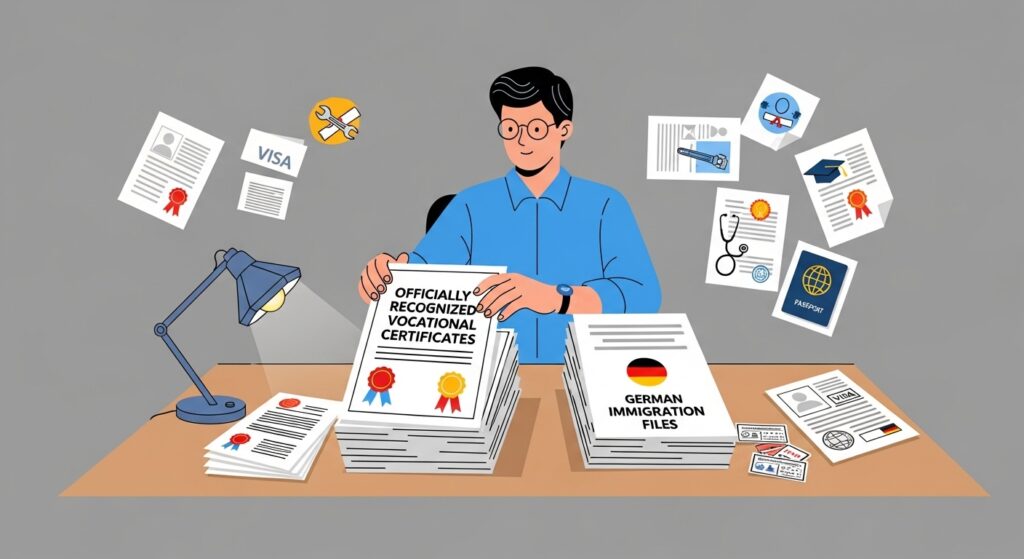
Under Section 18a of the Residence Act, third-country nationals possessing a recognized non-academic vocational qualification (Fachkraft mit Berufsausbildung) are eligible for a standard work visa. This pathway is critical for fulfilling industrial, logistical, and healthcare deficits.
The Absolute Requirement of Credential Recognition
The foundational pillar of this visa category is the formal recognition of foreign qualifications. The applicant's vocational training must be certified as entirely equivalent to the corresponding German dual-training framework. This process is adjudicated by specific federal and regional bodies, predominantly coordinated through the Central Office for Foreign Education (ZAB) and the respective chambers of commerce or crafts (IHK/HWK). If the qualification is deemed only partially equivalent, the applicant must apply for a separate visa for the recognition of foreign qualifications (Section 16d) to complete compensatory training within Germany before transitioning to a full work visa.
The Recognition Partnership (Anerkennungspartnerschaft)
To expedite the entry of skilled vocational workers, the 2026 regulatory framework includes the Recognition Partnership. This mechanism allows a foreign worker to enter Germany and commence employment immediately, provided they and their German employer commit to completing the formal credential recognition process simultaneously during the first year of employment. The applicant must possess at least two years of formal vocational training and A2 level German proficiency to utilize this partnership.
Visas for Freelancers and Entrepreneurs
Foreign nationals seeking to execute independent economic activities in Germany must apply for a residence permit for self-employment under Section 21 of the Residence Act. German administrative and tax law strictly bifurcates self-employment into two categories: liberal professions (Freiberufler) and commercial trades (Gewerbetreibende).
The Liberal Professions (Freiberufler)
Temporary visas for liberal professions are granted to independent consultants, IT specialists, artists, certified language teachers, and healthcare professionals operating outside a corporate employment structure. Applicants must submit a comprehensive portfolio, prove secure financing to maintain their livelihood, and provide explicit letters of intent from prospective German clients demonstrating a domestic economic demand for their specific services.
Commercial Trades and Enterprises (Gewerbe)
Entrepreneurs seeking to establish a commercial enterprise, retail operation, or import/export business face a higher evidentiary burden. The Federal Office for Migration and Refugees (BAMF) and local chambers of commerce evaluate the application based on regional economic need. The applicant must submit a rigorous business plan proving that the proposed enterprise will have a positive impact on the domestic economy, typically demonstrated by the creation of local jobs, substantial capital investment, and detailed revenue projections.
Consular Processing and Federal Compliance
Securing a valid employment contract or fulfilling the Opportunity Card points matrix represents only the preliminary phase of the immigration process. Adherence to strict consular and domestic compliance mandates is required to finalize legal residency.
The Fast-Track Procedure for Skilled Workers
To mitigate protracted processing times at diplomatic missions, German employers can initiate the Fast-Track Procedure for Skilled Workers (Beschleunigtes Fachkräfteverfahren) under Section 81a of the Residence Act. For a statutory fee, the employer acts as the authorized representative of the foreign worker, coordinating directly with the local Foreigners' Authority in Germany. The authority aggregates the necessary approvals from the Federal Employment Agency and credential recognition bodies. Once approved, the Federal Foreign Office is legally mandated to grant the applicant a visa appointment within three weeks, drastically accelerating the physical entry timeline.
Mandatory Domestic Registration
Physical entry into Germany is facilitated by a National Visa (Type D). However, this visa is temporary. Upon arrival, the foreign national must execute several mandatory administrative steps before the visa expires to convert it into a final electronic residence title (elektronischer Aufenthaltstitel - eAT):
- Residential Registration (Anmeldung): Within 14 days of securing permanent accommodation, the individual must register their physical address at the local Citizens' Registration Office (Bürgeramt). This generates the mandatory tax identification number (Steuer-ID).
- Statutory Health Insurance (Krankenversicherung): Proof of comprehensive health insurance meeting German statutory standards is an absolute prerequisite for the issuance of the residence title. Standard travel insurance is legally insufficient for long-term work visas.
- TIE Appointment: The applicant must schedule an appointment at the local Foreigners' Authority to submit biometric data and receive the physical eAT card. Commencing employment before receiving either the eAT or a specific provisional certificate (Fiktionsbescheinigung) constitutes illegal employment and is subject to immediate prosecution.
Complete Germany Visa Directory
- EU Blue Card in Germany: Requirements, Costs, and Steps for 2026
- Germany’s Shortage Occupations: In-Demand Jobs for International Workers (2026)
- English-Speaking Jobs in Germany: Visa Requirements and Reality
- German Language Requirements for Visas: Do You Need B1/B2 Certification?
- Average Salaries and Cost of Living for Expatriates in Germany (2026)
- Temporary Work Visas in Germany: Regulations for 2026
- Common Errors in German Work Visa Applications and How to Avoid Them
Disclaimer: This guide is for informational purposes only and is based on public data available for 2026. Visandwork.com is not a government agency, does not issue visas, and does not provide personalized legal or immigration advice. Always consult official government portals before initiating any application process.