English-Speaking Jobs in Germany: Visa Requirements and Reality
The Federal Republic of Germany represents the largest economy within the European Union and maintains a sustained structural demand for highly qualified international professionals. While German remains the official administrative and primary business language, demographic shifts and globalization have established a distinct, parallel labor market operating entirely in English. Navigating this sector requires a precise understanding of the legal frameworks administered by the Federal Office for Migration and Refugees (BAMF) and the Federal Employment Agency (Bundesagentur für Arbeit), alongside the practical realities of corporate integration.
The Reality of the English-Speaking Labor Market
The availability of English-only employment in Germany is strictly segmented by industry and geographic location. Foreign nationals seeking employment without German language proficiency (B1 level or higher on the CEFR scale) must target specific corporate environments to secure binding job offers.
Corporate Sectors with English Proficiency
The technology, software development, and digital engineering sectors are the primary sponsors of English-speaking foreign workers. Multinational corporations and established tech conglomerates operate internal communications exclusively in English to facilitate international project management. Secondary sectors include advanced scientific research at state-funded institutions (such as the Max Planck Society) and quantitative financial analysis within international banking hubs.
Conversely, highly regulated sectors such as clinical healthcare, public administration, law, and primary education mandate certified German proficiency (typically B2 or C1) by federal or state law, rendering English-only employment legally impossible in these fields.

Geographic Hubs for International Talent
English-speaking roles are highly concentrated in specific metropolitan areas characterized by robust startup ecosystems and international trade.
- Berlin: The epicenter of the German startup and digital tech industry, offering the highest volume of English-speaking roles in software engineering, digital marketing, and product management.
- Munich: Dominated by advanced manufacturing, automotive engineering, and aerospace technology conglomerates that recruit international engineers.
- Frankfurt am Main: The financial capital of the Eurozone, hosting the European Central Bank and numerous multinational financial institutions where English is the standard operating language.
Statutory Visa Requirements for Non-EU Citizens
Third-country nationals seeking to enter the German labor market must secure a residence title that explicitly permits employment. The modernized Skilled Immigration Act (Fachkräfteeinwanderungsgesetz) provides specific pathways for qualified workers, regardless of the language spoken in their prospective workplace.
The EU Blue Card (Section 18g AufenthG)
The EU Blue Card is the primary residence permit for highly qualified academic professionals. Administered under the regulations detailed by the Federal Office for Migration and Refugees (BAMF), this permit does not legally mandate German language proficiency for its initial issuance.
To qualify, applicants must hold a recognized university degree and present a binding employment contract from a company registered in Germany. The core requirement is meeting the statutory minimum salary thresholds, which are updated annually by the Federal Ministry of the Interior and Community (BMI):
- Standard Academic Professions: Requires a gross annual salary of approximately €45,300 (as of 2026 adjustments).
- Bottleneck Professions (Mangelberufe): Occupations experiencing severe labor shortages—specifically mathematicians, engineers, natural scientists, IT specialists, and medical doctors—benefit from a reduced salary threshold of approximately €41,041.80.
Under the current legal framework, IT specialists can secure an EU Blue Card without a formal university degree if they demonstrate at least three years of relevant professional experience acquired within the last seven years, provided the employment contract meets the lowered salary threshold.

The Opportunity Card (Chancenkarte) for Job Seekers
For individuals without a pre-existing job offer, the German government established the Opportunity Card (Chancenkarte). This points-based visa allows qualified foreign nationals to enter Germany for up to one year specifically to search for employment.
The points system evaluates age, professional experience, ties to Germany, and language proficiency. While German skills yield higher points, the legal framework explicitly recognizes English proficiency. Applicants can qualify for points by submitting formal proof of English language skills at the B2 level or higher, verified through standardized tests such as IELTS or the Cambridge English exams. While the Opportunity Card grants legal entry for job-seeking purposes, securing long-term employment requires transitioning to a standard work visa or an EU Blue Card before the initial 12-month validity period expires.
Verification of Academic and Vocational Credentials
Regardless of the corporate working language utilized by the prospective employer, German immigration law dictates the mandatory verification of foreign academic and vocational qualifications.
- The Anabin Database: Foreign university degrees must be officially recognized as comparable to a German academic degree. Adjudicating officers verify this status using the anabin database, maintained by the Central Office for Foreign Education (ZAB).
- Statement of Comparability: If the specific foreign degree or the issuing institution is not listed in the database, the applicant must formally apply for an official Statement of Comparability (Zeugnisbewertung) directly from the ZAB prior to submitting any visa application. Without this verified parity, the issuance of a work visa is legally prohibited.
Bureaucratic Realities and the Administrative Language Law
A critical reality for English-speaking professionals in Germany is the legal mandate governing public administration. According to Section 23 of the Administrative Procedure Act (Verwaltungsverfahrensgesetz - VwVfG), the official language of the state authorities is strictly German.
The Local Foreigners' Authority (Ausländerbehörde)
While federal portals and international diplomatic missions provide preliminary information in English, interactions at the municipal level are conducted in German. This specifically applies to the Citizens' Registration Office (Bürgeramt) and the local Foreigners' Authority (Ausländerbehörde). Public servants are not legally obligated, and often not permitted, to provide legally binding administrative guidance in a foreign language. Consequently, applicants frequently require a German-speaking interpreter or certified relocation consultant to successfully navigate residential registration (Anmeldung) and the physical issuance of electronic residence permits.

Legal Contracts and Taxation
Expatriates employed in English-speaking roles must still navigate statutory civilian obligations where English holds no legal standing:
- Employment Contracts: While multinational corporations may provide an English translation for convenience, the legally binding version of the employment agreement governed by German labor law (Arbeitsrecht) is the German text. Disputes are settled based on the German phrasing.
- Taxation: Communication with the Federal Central Tax Office (Bundeszentralamt für Steuern) and local tax offices (Finanzamt), including the mandatory annual tax declarations (Steuererklärung), is processed entirely in German.
- Statutory Health Insurance: Enrollment procedures, policy documents, and official communications with public health insurance providers (Krankenkassen) are standardly issued in German.
Permanent Settlement and the German Language Mandate
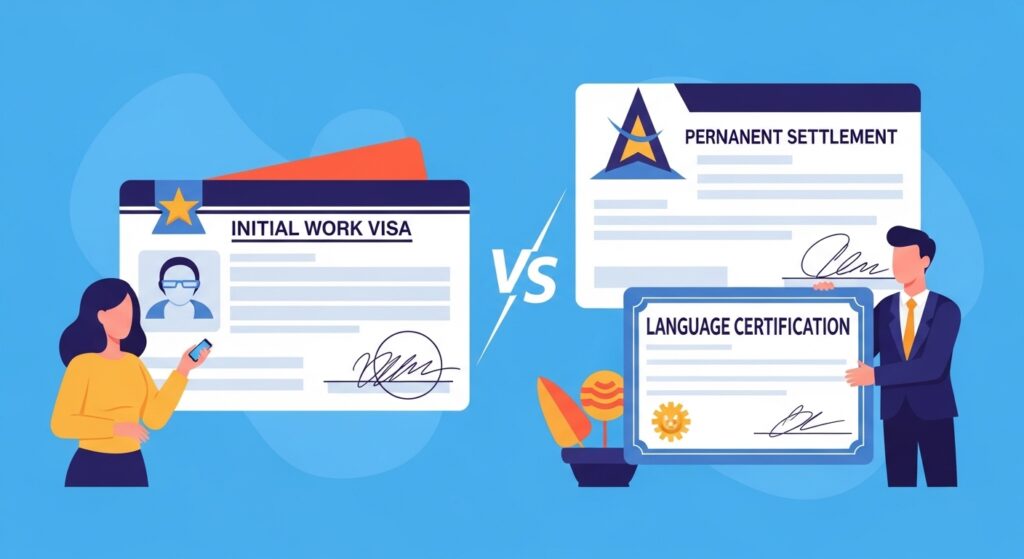
While initial entry and sustained temporary employment in specific digital and scientific sectors are feasible using only English, the German federal government strictly enforces language requirements for foreign nationals seeking permanent legal integration. The permanent settlement permit (Niederlassungserlaubnis) cannot be obtained through English proficiency.
Standard Permanent Residency Requirements
Foreign workers holding a standard employment residence permit must demonstrate verified German language proficiency at the B1 level of the CEFR scale, alongside completing 60 months of mandatory contributions to the statutory pension insurance system, to qualify for permanent settlement.
EU Blue Card Accelerated Pathways
The EU Blue Card framework provides an accelerated timeline for permanent residency, but the legislative linguistic mandate remains a strict barrier:
- The 33-Month Track: An EU Blue Card holder is legally entitled to apply for permanent settlement after 33 months of highly qualified employment and continuous pension contributions. This specific track mandates certified German language skills at the A1 level (basic proficiency).
- The 21-Month Track: The statutory waiting period is reduced to 21 months exclusively for cardholders who can demonstrate certified German language proficiency at the B1 level.
Therefore, international professionals operating entirely within an English-speaking corporate bubble must actively pursue German language acquisition through state-certified institutions (such as the Goethe-Institut or telc) to secure long-term, unrestricted residency rights within the Federal Republic.
Read more about: [Navigating German Freelance and Self-Employment Visas (Freiberufler)]
Disclaimer: This guide is for informational purposes only and is based on public data available for 2026. Visandwork.com is not a government agency, does not issue visas, and does not provide personalized legal or immigration advice. Always consult official government portals before initiating any application process.