Common Errors in German Work Visa Applications and How to Avoid Them
The Federal Republic of Germany regulates the entry of third-country nationals through a strict statutory framework governed by the Residence Act (Aufenthaltsgesetz). The Federal Office for Migration and Refugees (BAMF) and the Federal Foreign Office (Auswärtiges Amt) adjudicate thousands of employment visa applications annually. Due to the exact administrative standards required, minor procedural errors frequently result in extended processing delays, requests for supplementary documentation, or outright visa refusals. This document identifies the most prevalent documentary and procedural errors committed during the German work visa application process and details the statutory requirements necessary to prevent them.
Deficiencies in Academic and Vocational Credential Recognition
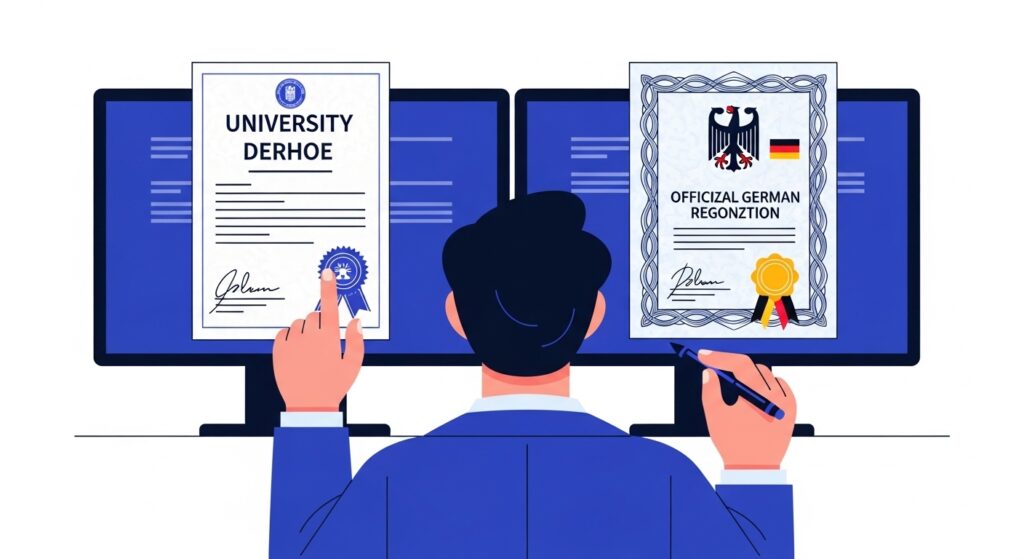
A foundational requirement for employment visas, particularly the EU Blue Card under Section 18g of the Residence Act, is the possession of a recognized academic or vocational qualification. A primary error is submitting foreign diplomas without official German verification.
Failing to Consult the Anabin Database
Applicants frequently assume their foreign university degree is automatically recognized in Germany. The Central Office for Foreign Education (ZAB) maintains the anabin database, the official registry for evaluating foreign qualifications. An application will be suspended or refused if the applicant fails to provide printouts from the anabin database proving that both their foreign university is rated "H+" and their specific degree is categorized as equivalent to a German qualification.
Omitting the Statement of Comparability
If an applicant's degree or institution is not listed in the anabin database, they must formally apply for a Statement of Comparability (Zeugnisbewertung) directly from the ZAB. A critical procedural error is submitting the visa application while the Statement of Comparability is still pending. Diplomatic missions require the finalized ZAB certificate at the time of the visa interview; application receipts or payment confirmations are not legally sufficient to prove academic equivalence.
Discrepancies in the Declaration of Employment
Standard work visas and the EU Blue Card require a binding job offer. To process this, the German employer must complete the official "Declaration regarding a contract of employment" (Erklärung zum Beschäftigungsverhältnis). Errors within this document directly trigger rejections from the Federal Employment Agency (Bundesagentur für Arbeit).
Insufficient Salary Thresholds
The Federal Ministry of the Interior and Community sets mandatory minimum salary thresholds for specific visa categories, which are updated annually. A common error occurs when the gross annual salary stated in the employment contract falls below these statutory limits. For example, if an applicant applies for an EU Blue Card in a non-bottleneck profession, the contract must guarantee a specific minimum gross salary. If the contract lists a base salary below this threshold and attempts to reach the minimum by including variable performance bonuses, housing allowances, or unverified overtime pay, the Federal Employment Agency will reject the application, as only guaranteed basic gross pay is legally recognized for threshold calculations.
Misalignment of Job Duties and Qualifications
German immigration law dictates that the prospective employment must be commensurate with the applicant's academic or vocational qualifications. If an applicant holds a master's degree in mechanical engineering, but the submitted job description outlines duties equivalent to a basic administrative assistant or a Tier 1 IT support role, the visa will be denied. The adjudicating officer must see a direct, logical correlation between the verified educational credentials and the daily responsibilities detailed in the Declaration of Employment.
Invalid or Incomplete Health Insurance Coverage
Section 2 of the Residence Act mandates that foreign nationals must possess adequate health insurance coverage (Krankenversicherung) from the moment they enter German territory.
Confusing Travel Insurance with Statutory Coverage
A pervasive error is submitting standard tourist travel insurance to fulfill the visa requirement. Tourist insurance typically covers only emergency repatriation and acute accidents. The German diplomatic missions require proof of incoming health insurance that aligns with German statutory standards, covering comprehensive medical treatments, hospital stays, and pre-existing conditions without extremely low coverage caps.
Activation Date Errors
Applicants frequently submit health insurance policies that activate strictly on the date their employment contract begins. However, if the applicant intends to enter Germany a week prior to the start of employment to secure housing and complete residential registration, they are legally uninsured during that interim period. The visa application will be flagged, and the applicant will be required to purchase supplementary incoming insurance to cover the exact date of physical entry into the Schengen Area.
Errors Regarding Mandatory Language Certifications
While the EU Blue Card does not statutorily require German language proficiency prior to entry, several other visa categories—such as visas for vocational training, job seeking, and specific regulated professions—mandate verified language skills based on the Common European Framework of Reference for Languages (CEFR).
Submitting Unrecognized Certificates
A frequent ground for refusal is the submission of language certificates from unaccredited online platforms or private tutors. German immigration authorities exclusively recognize certificates issued by testing centers approved by the federal government, such as the Goethe-Institut, telc, TestDaF, or ÖSD. Certificates lacking official federal recognition will be summarily rejected, regardless of the applicant's actual communicative fluency.
Expired Certifications
Furthermore, language certificates have a strict administrative lifespan. The Federal Foreign Office generally requires that A1 or B1 certificates be no older than 12 months at the time of the visa application submission. Submitting an officially recognized but severely outdated certificate will lead to an immediate request for a re-examination, stalling the visa process for months while the applicant secures a new testing appointment.
Procedural and Timing Errors
Beyond documentary deficiencies, logistical missteps regarding the application timeline frequently jeopardize work visa approvals and compromise legal residency status.
Premature Entry on Visa Waivers
Citizens of certain nations (including the United States, Canada, Australia, Japan, and South Korea) are permitted to enter Germany visa-free for up to 90 days and apply for their residence permit directly at the local Foreigners' Authority (Ausländerbehörde). A critical, non-reversible error is commencing employment during this 90-day waiting period before the physical work permit is officially issued. Working without the explicit statutory authorization printed on a residence title constitutes illegal employment. This violation results in immediate administrative penalties, deportation proceedings, and a multi-year ban from entering the Schengen Area.

Failing to Register Locally (Anmeldung)
For applicants who successfully obtain a National Visa (Type D) from their home country, the administrative process does not conclude upon arrival. German law requires all residents to register their physical address (Anmeldung) at the local Citizens' Registration Office (Bürgeramt) within 14 days of moving into a permanent residence.
Failing to complete this registration halts all subsequent integration steps. Without the resulting registration certificate (Meldebescheinigung), the applicant cannot obtain a tax identification number (Steuer-ID) from the Federal Central Tax Office or finalize a permanent statutory health insurance policy. Without these elements, the employer cannot legally process the payroll, and the Foreigners' Authority will refuse to convert the temporary National Visa into the final electronic residence permit (eAT).
Missing Extension Deadlines
Temporary work visas and EU Blue Cards are issued with strict expiration dates. A pervasive compliance error is failing to apply for an extension before the current permit expires. If an application for extension is submitted before the expiration date, the applicant is granted a "fictional status" (Fiktionsbescheinigung), allowing them to continue working legally under their previous conditions while the new application is processed. If the residence permit expires before the extension is formally filed, the foreign national is immediately considered to be residing illegally in Germany, must cease all employment operations instantly, and faces potential removal proceedings.
Verification and Legalization Oversights
The German bureaucratic system demands absolute authenticity of civil documents, extending beyond university degrees to include all vital records required for family integration.
Missing Apostilles and Legalizations
When applying for dependent visas for spouses or minor children alongside a primary work visa, applicants must submit marriage and birth certificates. A systemic error is submitting these foreign civil documents without the required international authentication. Depending on the issuing country, Germany legally requires either an Apostille (for countries participating in the Hague Convention) or a formal diplomatic legalization conducted by the German embassy in the document's country of origin. Submitting unauthenticated vital records results in the immediate denial of the family reunification application.
Inadequate Translations
German administrative law dictates that all vital records and legal documents not originally issued in German (and occasionally English, depending on the specific municipal authority) must be accompanied by a certified translation. A common error is utilizing standard commercial translation agencies or submitting self-translated documents. The Federal Foreign Office exclusively accepts translations completed by a sworn translator (vereidigter Übersetzer) officially recognized and registered by a German regional court.

Material Misrepresentation
The most severe error in the German immigration process is the intentional or negligent misrepresentation of material facts. Under the Residence Act, providing false information on a visa application is classified as a criminal offense.
Undisclosed Immigration History
Applicants frequently fail to disclose prior visa refusals, deportations, or minor criminal convictions, operating under the assumption that German authorities only verify domestic data. However, the Federal Police (Bundespolizei) and immigration authorities systematically utilize the Schengen Information System (SIS), which aggregates security, criminal, and immigration data across the entire European Union.
If an adjudicating officer discovers an undisclosed prior visa refusal from another Schengen member state, an overstay violation, or a hidden criminal record, the application is denied immediately based on deception. Consequently, the applicant is flagged in the SIS, effectively banning them from obtaining any future visas for the entire Schengen Area. Absolute transparency, rigorous adherence to statutory document requirements, and meticulous timeline management are the only proven methodologies to successfully navigate the German employment visa framework and avoid critical processing failures.
Read more about: [The German Opportunity Card (Chancenkarte): Point System Breakdown]
Disclaimer: This guide is for informational purposes only and is based on public data available for 2026. Visandwork.com is not a government agency, does not issue visas, and does not provide personalized legal or immigration advice. Always consult official government portals before initiating any application process.