German Language Requirements for Visas: Do You Need B1/B2 Certification?
The Federal Republic of Germany regulates the entry and residence of third-country nationals through the Residence Act (Aufenthaltsgesetz - AufenthG). Within this statutory framework, verified German language proficiency is frequently a mandatory prerequisite for specific visas, residence permits, and pathways to permanent settlement. The Federal Office for Migration and Refugees (BAMF) and local Foreigners' Authorities (Ausländerbehörden) enforce these linguistic requirements to ensure societal integration and occupational safety. This document details the exact language certifications required for various German visa categories in 2026, clarifying when B1 or B2 certification is legally mandated and when applicants are exempt.

The Common European Framework of Reference for Languages (CEFR)
German immigration authorities exclusively recognize language certificates aligned with the Common European Framework of Reference for Languages (CEFR). The CEFR categorizes language proficiency into six distinct levels: A1 and A2 (Basic User), B1 and B2 (Independent User), and C1 and C2 (Proficient User).
To satisfy visa requirements, applicants must submit examination certificates from testing institutions explicitly approved by the German federal government. Recognized providers include:
- Goethe-Institut
- telc (The European Language Certificates)
- TestDaF-Institut
- Österreichisches Sprachdiplom Deutsch (ÖSD)
Certificates from non-accredited language schools or informal online courses are legally invalid for immigration purposes.
Visa Categories Exempt from Pre-Arrival Language Requirements
Certain highly qualified employment visas prioritize specialized professional skills and salary thresholds over immediate linguistic integration. In these cases, the applicant is not required to submit a German language certificate to the diplomatic mission prior to entry.
The EU Blue Card (Section 18g AufenthG)
The EU Blue Card is the primary residence permit for academics and IT specialists from non-EU states. The statutory requirements for the initial issuance of an EU Blue Card are strictly based on the possession of a recognized academic degree (or equivalent IT experience) and a binding employment contract meeting specific minimum salary thresholds. There is no legal requirement to prove German language proficiency at the A1, B1, or B2 level to obtain this initial visa, even if the corporate working language is German.
Intra-Corporate Transfers (ICT Card)
Managers, specialists, and trainees transferred to a German branch of their multinational corporation under the ICT Directive (Section 19b AufenthG) are exempt from providing language certificates. The legislative assumption is that these assignments are temporary and operate within an international corporate environment.
Visas Requiring Basic to Intermediate German (A1 – B1)
For visas oriented toward vocational training, job seeking, or standard family reunification, the Residence Act mandates verified language skills to facilitate immediate integration.
Family Reunification (Familiennachzug)
Under Section 30 of the Residence Act, spouses of foreign nationals residing in Germany must generally demonstrate basic German skills at the A1 level before a dependent visa is issued. This requires passing a recognized A1 exam in the home country. However, strict statutory exemptions exist. Spouses are exempt from the A1 requirement if the primary visa holder possesses an EU Blue Card, an ICT Card, or is a highly qualified researcher under Section 18d AufenthG.
The Opportunity Card (Chancenkarte)
Introduced to streamline job seeking, the Opportunity Card utilizes a points-based system. To qualify for the base requirements, applicants must prove either German language proficiency at the A1 level or English proficiency at the B2 level. If the applicant relies on English to meet the baseline, acquiring German language certificates at the A2, B1, or B2 level awards significant additional points, substantially increasing the likelihood of securing the visa.
Skilled Workers with Vocational Training
For applicants entering the German labor market based on recognized vocational training (Section 18a AufenthG) rather than an academic degree, language requirements are strictly enforced. The Federal Employment Agency typically requires the applicant to possess the language skills necessary for the specific occupational environment. In practice, local authorities and employers demand a minimum of B1 certification to ensure workplace safety and operational comprehension.
Visas Requiring Advanced German (B2 – C1)
Specific regulated professions and educational pathways legally mandate advanced language proficiency to ensure public safety and administrative accuracy.
Healthcare and Medical Professions
Medical professionals face the most stringent language requirements under German law. To obtain a license to practice medicine (Approbation) or authorization to practice a nursing profession (Berufserlaubnis), applicants must navigate procedures dictated by the state health authorities (Landesgesundheitsämter).
- Registered Nurses: Must generally prove general German proficiency at the B2 level. Additionally, they often need to pass a specialized medical language examination (Fachsprachenprüfung) administered by the respective state medical or nursing chambers. This specialized assessment strictly tests clinical vocabulary, patient consultation scenarios, and the ability to draft accurate medical reports, typically demanding a C1 level of specialized medical German. Failure to pass this examination prevents the issuance of the permanent state license to practice.
Education and Pedagogy
Teachers (Lehrer) and early childhood educators (Erzieher) operate within regulated professions heavily dependent on communication. Because these professionals directly influence the linguistic and cognitive development of children within the state school system, ministries of education (Kultusministerien) across all federal states universally mandate verified German language skills at the C1 level. In specific secondary education roles, particularly for teaching subjects like German literature or history, authorities may require C2 certification.
Language Requirements for Permanent Settlement (Niederlassungserlaubnis)
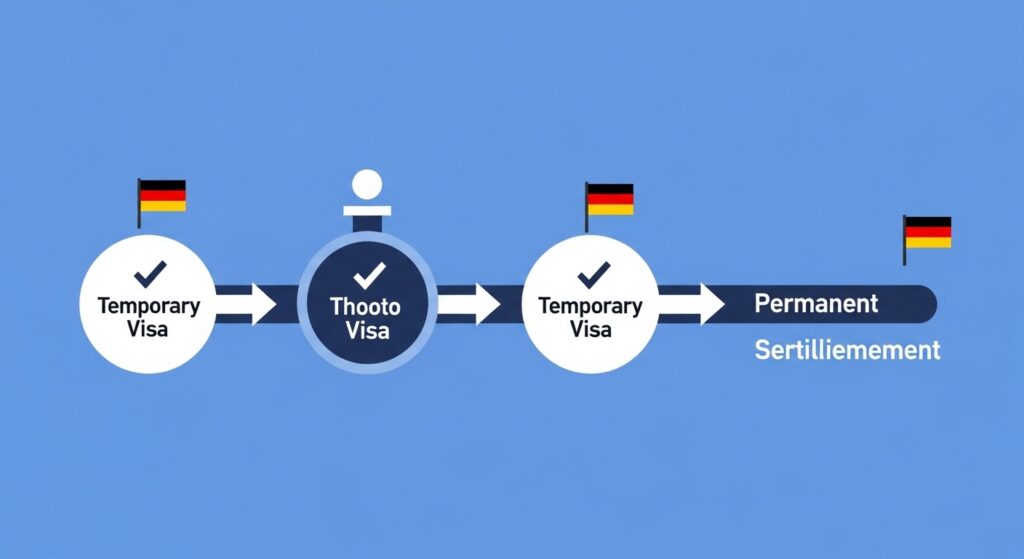
The transition from a temporary residence permit to a permanent settlement permit (Niederlassungserlaubnis) requires definitive proof of societal and linguistic integration. The required language level dictates the speed at which an applicant can secure permanent residency.
The Standard B1 Pathway
Under the standard regulations detailed in Section 9 of the Residence Act, foreign nationals must prove general German proficiency at the B1 level to qualify for permanent residency. This linguistic requirement is coupled with the necessity of demonstrating 60 months of mandatory financial contributions to the German statutory pension insurance system (Gesetzliche Rentenversicherung).
Accelerated Pathways for Skilled Workers and EU Blue Card Holders
The Skilled Immigration Act established accelerated settlement pathways for highly qualified workers, leveraging language proficiency as a primary catalyst for faster processing.
- Standard Skilled Workers: Professionals holding a residence permit for qualified employment (under Section 18a or 18b AufenthG) can apply for a settlement permit after 48 months, provided they possess a valid B1 language certificate.
- EU Blue Card Holders (33 Months): Cardholders are legally entitled to apply for permanent settlement after 33 months of highly qualified employment. This specific track mandates certified German language skills at the A1 level.
- EU Blue Card Holders (21 Months): The statutory waiting period is significantly reduced to 21 months exclusively for EU Blue Card holders who can demonstrate certified German language proficiency at the B1 level.
Language Requirements for Naturalization (Einbürgerung)
Acquiring German citizenship represents the final step of administrative integration. The requirements for naturalization are outlined in the Nationality Act (Staatsangehörigkeitsgesetz - StAG) and carry strict linguistic benchmarks.
Standard Naturalization (B1)
The baseline requirement for standard naturalization is the submission of a recognized B1 language certificate. This documentation serves as legal proof that the applicant possesses sufficient ability to participate in everyday German life, comprehend standard media, and interact autonomously with public authorities and municipal administrations.
Accelerated Naturalization (C1)
Under recent structural reforms to the Nationality Act, the German government established rapid naturalization tracks for individuals demonstrating "special integration achievements." Acquiring a C1 language certificate is explicitly categorized as a special integration achievement. Applicants who achieve C1 proficiency can apply for naturalization after just three years of legal continuous residence, significantly reducing the standard statutory waiting periods.
The BAMF Integration Courses (Integrationskurse)
To facilitate language acquisition and ensure foreign nationals can meet visa and settlement requirements, the federal government heavily subsidizes Integration Courses. These courses are orchestrated by BAMF and conducted by certified private language schools. A standard integration course consists of a language module designed to bring the participant to the B1 level, followed by an orientation course covering German law, history, and constitutional values.
Mandatory Participation Orders
Foreigners' Authorities possess the statutory right to compel a foreign national to attend an integration course if their language skills are deemed demonstrably insufficient (typically below A1) upon initial residential registration or visa extension. Refusal to comply with a mandatory attendance order (Verpflichtung zur Teilnahme am Integrationskurs) can result in administrative fines, the denial of visa extensions, or the immediate rejection of permanent settlement applications.
Financial Subsidies and Refunds
For individuals mandated to attend, or those holding specific employment and family reunification visas who voluntarily apply for authorization (Berechtigungsschein), BAMF heavily subsidizes the hourly tuition cost. Furthermore, participants who successfully pass the final standardized examination, the "Deutsch-Test für Zuwanderer" (DTZ), at the B1 level within two years of receiving their eligibility certificate can apply to BAMF for a 50% refund of their out-of-pocket tuition expenses.

Statutory Exemptions from Language Requirements
German immigration law provides narrow, strictly regulated exemptions for individuals who cannot reasonably be expected to fulfill the language mandates due to severe hardship or incapacitation.
Medical and Cognitive Exemptions
Applicants who are fundamentally unable to acquire the required language proficiency due to a severe physical, mental, or psychological illness or disability are exempt from providing A1, B1, or B2 certificates. However, this exemption cannot be self-declared or supported by a standard doctor's note. The applicant must submit a comprehensive, formalized medical assessment (amtsärztliches Gutachten) conducted by a state-approved public health officer (Amtsarzt) explicitly confirming the individual's inability to learn a new language.
Age-Related Hardship Exemptions
In specific family reunification cases or when evaluating long-term residents for permanent settlement, the Foreigners' Authority may consider significant advanced age as a mitigating factor. If the applicant's advanced age demonstrably prevents the successful acquisition of a new language, the requirement may be waived. This exemption is adjudicated on a strict, case-by-case basis and requires the applicant to prove that all reasonable efforts to learn German have already been exhausted without success.
Read more about: [German Citizenship Act 2026: Dual Citizenship and Naturalization Timelines]
Disclaimer: This guide is for informational purposes only and is based on public data available for 2026. Visandwork.com is not a government agency, does not issue visas, and does not provide personalized legal or immigration advice. Always consult official government portals before initiating any application process.