EU Blue Card in Germany: Requirements, Costs, and Steps for 2026
The EU Blue Card is the primary residence title for highly qualified third-country nationals seeking employment in the Federal Republic of Germany. Governed by Section 18g of the German Residence Act (AufenthG), this framework implements the European Union’s directive to attract global talent and address structural labor shortages within the European economic area. The processing and regulation of these permits fall under the jurisdiction of the Federal Office for Migration and Refugees (BAMF) and local Foreigners' Authorities (Ausländerbehörde).

Statutory Requirements for the EU Blue Card
To qualify for an EU Blue Card in Germany, applicants must fulfill strict criteria regarding their educational background, professional experience, and the specific terms of their prospective employment. The Federal Employment Agency (Bundesagentur für Arbeit) actively monitors these criteria to ensure compliance with domestic labor standards.
Academic and Professional Qualifications
The foundational requirement is the possession of a recognized university degree.
- German Degree: A degree acquired at a German higher education institution automatically qualifies.
- Foreign Degree: If the degree was obtained outside of Germany, it must be officially recognized or evaluated as comparable to a German academic degree. Applicants must utilize the anabin database, maintained by the Central Office for Foreign Education (ZAB), to verify the status of their foreign university and the specific degree.
- IT Specialists Exemption: Under the revised Skilled Immigration Act, IT specialists may qualify for an EU Blue Card without a formal university degree if they can demonstrate at least three years of relevant professional experience within the last seven years, possessing skills equivalent to an academic level.
The Binding Job Offer
The applicant must secure a binding job offer or present a signed employment contract from a company registered in Germany. The employment must be appropriate to the applicant's academic qualifications, and the contract must guarantee a minimum duration of at least six months.
Minimum Salary Thresholds for 2026
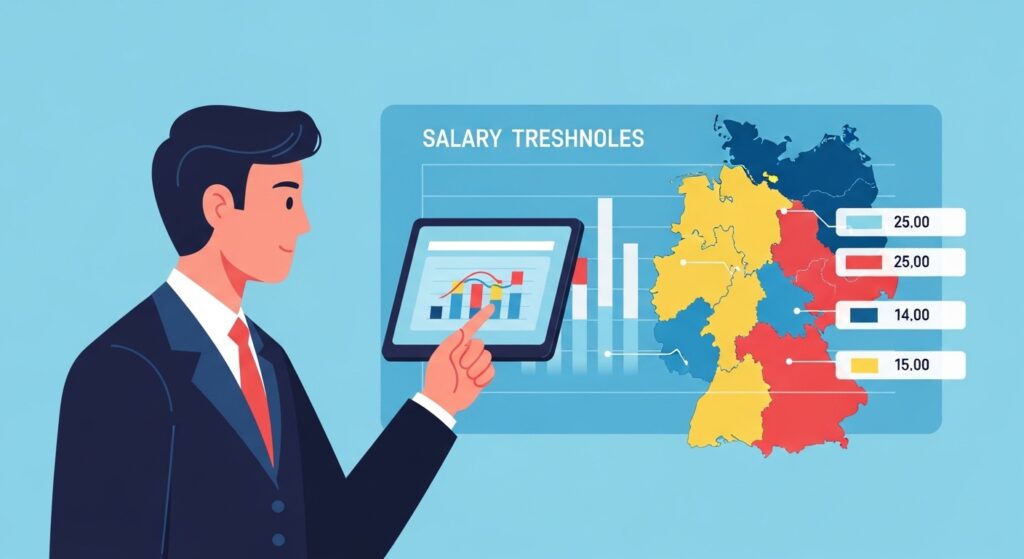
A core mechanism of the EU Blue Card system is the enforcement of statutory minimum salary thresholds. These financial benchmarks are updated annually by the Federal Ministry of the Interior and Community (BMI) to reflect wage developments in the German labor market.
Standard and Bottleneck Professions
The German government utilizes two distinct salary thresholds based on the National Occupational Classification.
- Standard Professions: For regular academic professions, the statutory minimum gross annual salary is established at approximately €45,300.
- Bottleneck Professions (Mangelberufe): To address acute labor deficits in specific sectors, a lowered salary threshold of approximately €41,041.80 applies to bottleneck professions. This category includes mathematicians, engineers, natural scientists, human medicine doctors, IT specialists, veterinarians, dentists, pharmacists, and academic nursing professionals.
Employers must guarantee this remuneration without relying on variable performance bonuses, allowances, or unverified overtime pay.
Associated Costs and Government Fees
Securing an EU Blue Card involves standardized administrative fees levied by the German federal government and diplomatic missions abroad. These costs do not include private expenses such as translation services, document notarization, or travel.
- National Visa (Type D) Fee: The initial entry visa processed by the German embassy or consulate typically costs €75.
- EU Blue Card Issuance Fee: Once in Germany, the local Foreigners' Authority charges a fee for issuing the physical residence permit. For a validity period of up to one year, the fee is approximately €100. For a validity period exceeding one year, the fee is €100 to €110.
- Extension Fees: Extending the EU Blue Card incurs additional administrative costs, generally ranging from €93 to €98.
Step-by-Step Application Process
The administrative procedure to obtain an EU Blue Card is highly structured. It requires coordination between the applicant, the German employer, the local diplomatic mission, and domestic immigration authorities.
Phase 1: Securing the Visa for Entry (National Visa D)
Unless the applicant is a citizen of a country exempt from entry visa requirements (such as Australia, Canada, Israel, Japan, New Zealand, South Korea, the United Kingdom, or the United States), they must apply for a National Visa (Type D) for the purpose of employment before traveling to Germany.
- Appointment Booking: The applicant must schedule an appointment at the competent German Embassy or Consulate in their country of residence.
- Document Submission: Required documentation includes a valid passport, biometric passport photos, the completed visa application form, the signed employment contract or binding job offer, the "Declaration regarding a contract of employment" (Erklärung zum Beschäftigungsverhältnis) completed by the employer, proof of academic qualifications (including anabin printouts or ZAB Statement of Comparability), and proof of adequate statutory or private health insurance coverage valid from the date of entry.
- Federal Employment Agency Approval: In many cases, the diplomatic mission will internally forward the application to the Federal Employment Agency to verify that the employment conditions meet German labor standards and that the foreign worker is not being employed under less favorable working conditions than comparable German citizens. Once this verification is complete, the diplomatic mission issues the National Visa, allowing the applicant to legally enter the Federal Republic of Germany and commence employment.
Phase 2: Residential Registration (Anmeldung)
Upon arriving in Germany, the first legally mandated administrative step is residential registration, known as Anmeldung. Under the German Federal Registration Act (Bundesmeldegesetz), all residents must register their physical address at the local Citizens' Registration Office (Bürgeramt or Einwohnermeldeamt) within 14 days of moving in.
- Required Documents: The applicant must present their passport with the valid entry visa and a confirmation of residence signed by the landlord (Wohnungsgeberbestätigung).
- The Registration Certificate: Successful registration generates a Meldebescheinigung. This official certificate is a strict prerequisite for subsequent administrative processes, including opening a German bank account, securing a permanent statutory health insurance policy, and obtaining a tax identification number (Steueridentifikationsnummer) from the Federal Central Tax Office.
Phase 3: Applying for the Physical EU Blue Card
The National Visa utilized for entry is temporary, typically valid for three to six months. Before this visa expires, the foreign national must convert it into the formal EU Blue Card residence title at the local Foreigners' Authority (Ausländerbehörde) responsible for their registered district.
- Scheduling the Appointment: Due to high administrative volumes, applicants must secure an appointment well in advance.
- Final Document Submission: The applicant must submit their passport, the Meldebescheinigung, biometric passport photographs, the finalized employment contract, current pay slips (if employment has already begun), and proof of comprehensive health insurance.
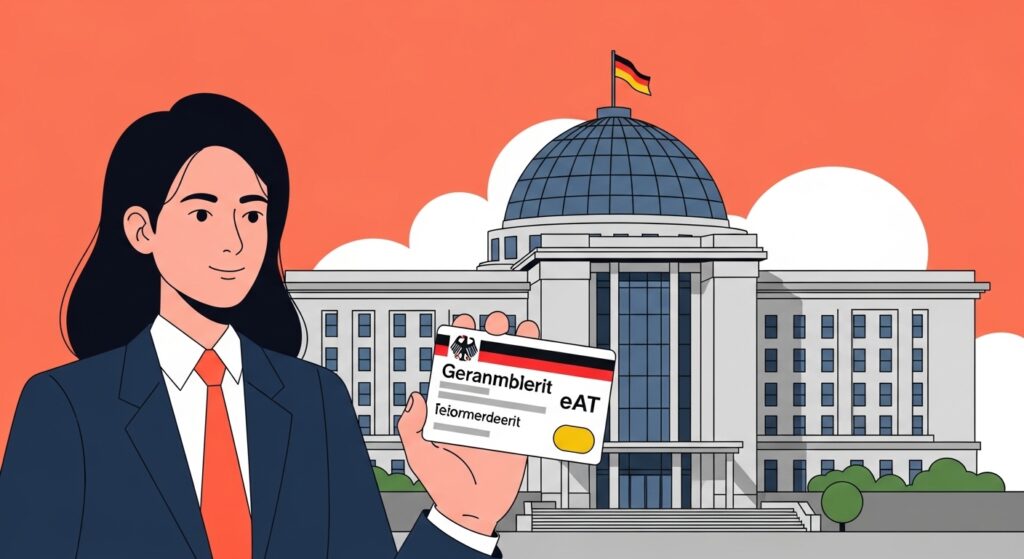
- Issuance: The Foreigners' Authority will order an electronic residence permit (elektronischer Aufenthaltstitel, eAT) printed as a plastic card containing an embedded biometric chip. This card explicitly states the holder's right to engage in highly qualified employment.
Family Reunification (Familiennachzug)
The EU Blue Card provides highly advantageous regulatory frameworks for family reunification, acknowledging that highly skilled professionals require stable family integration.
- Spouses and Minor Children: Cardholders have the statutory right to bring their spouse and unmarried minor children to Germany.
- Language Exemptions: Crucially, spouses of EU Blue Card holders are entirely exempt from the requirement to prove basic German language proficiency (A1 level) prior to receiving their dependent visa. This is a significant waiver compared to standard German family reunification visas.
- Labor Market Access: Upon issuance of the dependent residence permit, the spouse is immediately granted unrestricted access to the German labor market, permitting them to seek employment or engage in self-employed commercial activities without requiring separate approval from the Federal Employment Agency.
Pathways to Permanent Residency (Niederlassungserlaubnis)
The German government explicitly structured the EU Blue Card as a fast-track pathway to a permanent settlement permit (Niederlassungserlaubnis), incentivizing global talent to remain in the country long-term.
The Standard 33-Month Track
Cardholders are legally entitled to apply for a permanent settlement permit after completing 33 months of highly qualified employment. To qualify, the applicant must demonstrate that they have made mandatory contributions to the German statutory pension insurance system (Gesetzliche Rentenversicherung) for the duration of this 33-month period. Additionally, they must possess basic German language skills, defined as level A1 according to the Common European Framework of Reference for Languages (CEFR).
The Accelerated 21-Month Track
The waiting period for permanent residency is significantly reduced if the cardholder demonstrates advanced linguistic integration. If the applicant can prove German language proficiency at the B1 CEFR level (typically via a certified examination from the Goethe-Institut or telc), they are eligible to apply for the Niederlassungserlaubnis after just 21 months of employment and pension contributions.
Employment Mobility and European Integration
The EU Blue Card is tied to the specific employer that sponsored the initial application, but this restriction is temporary, and the permit facilitates significant domestic and international mobility.
Changing Employers within Germany
During the first 12 months of employment, an EU Blue Card holder may only change jobs with the explicit prior permission of the Foreigners' Authority. The authority will re-evaluate the new employment contract to ensure it still meets the statutory salary thresholds and aligns with the applicant's qualifications. If the new position fails to meet these criteria, the job change will be denied, and the Blue Card may be revoked.
After completing 12 months of highly qualified employment, the cardholder is legally authorized to change employers without seeking prior approval from the Foreigners' Authority, provided the new position continues to meet all mandatory EU Blue Card requirements. The cardholder is only required to notify the authority of the change for administrative record-keeping.

Intra-European Mobility
In alignment with the European Union directive, the German EU Blue Card facilitates mobility across participating member states. After holding a German EU Blue Card for 18 continuous months, the foreign national is permitted to move to another EU member state (excluding Denmark and Ireland, which opted out of the directive) for the purpose of highly qualified employment. In this scenario, the applicant does not need to secure an initial entry visa from their home country; they can submit their application for the new country's EU Blue Card within one month of arriving in that second member state.
Read more about: [The German Opportunity Card (Chancenkarte) for International Job Seekers]
Disclaimer: This guide is for informational purposes only and is based on public data available for 2026. Visandwork.com is not a government agency, does not issue visas, and does not provide personalized legal or immigration advice. Always consult official government portals before initiating any application process.