UK Work Visa Categories, Minimum Salary Thresholds, and Costs (2026)
The United Kingdom operates a points-based immigration system managed by the Home Office through UK Visas and Immigration (UKVI). This framework dictates the entry and residency of foreign nationals seeking employment within the UK labor market. To secure authorization, applicants must navigate specific visa categories, meet strict skill and salary thresholds, and pay mandatory government fees. This document outlines the primary work visa routes, the statutory financial requirements, and the associated application costs applicable in 2026.

The Skilled Worker Visa Route
The Skilled Worker visa is the primary immigration route for foreign nationals holding a confirmed job offer from a UK employer approved by the Home Office.
Mandatory Points Requirement
Applicants must score a total of 70 points to qualify. Fifty of these points are mandatory and non-tradable, requiring:
- A valid Certificate of Sponsorship (CoS) from an approved UK employer.
- A job offer at the required skill level, defined as Regulated Qualifications Framework (RQF) level 3 or above (equivalent to A-levels).
- Proven English language proficiency to at least level B1 on the Common European Framework of Reference for Languages (CEFR).
The remaining 20 tradable points are typically obtained by meeting or exceeding the specific salary thresholds designated for the occupation.
Minimum Salary Thresholds for 2026
The UK government utilizes strict salary thresholds to protect the domestic labor market and ensure foreign workers are adequately compensated. The Home Office mandates that employers pay the highest of three specific metrics.
The General Salary Threshold and the Going Rate
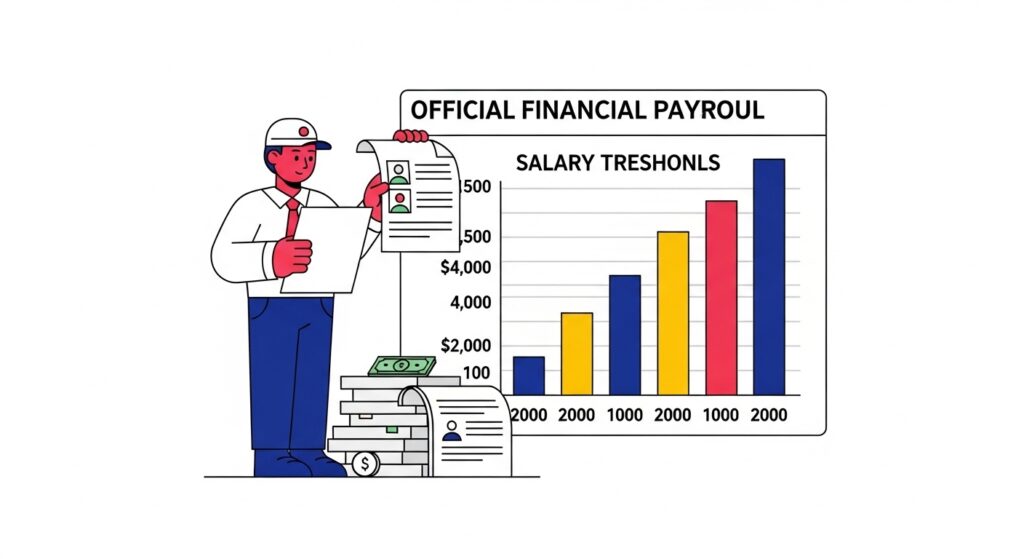
Under the standard Skilled Worker route, the baseline general salary threshold is set at £38,700 per year. However, applicants must be paid the higher of this general threshold or the specific "going rate" for their particular Standard Occupational Classification (SOC) code. These going rates are based on the Annual Survey of Hours and Earnings (ASHE) data and are continuously updated in the Immigration Rules Appendix Skilled Occupations. If an occupation's going rate is £45,000, the applicant must earn at least £45,000, regardless of the £38,700 general threshold.
Salary Discounts for New Entrants and Specific Qualifications
The immigration framework allows for specific salary discounts, enabling applicants to score the required 20 tradable points even if they do not meet the standard £38,700 threshold.
- New Entrants: Applicants under the age of 26, recent UK university graduates, or those in recognized professional training programs may qualify as "new entrants." They can be paid 70% of the standard going rate for their occupation, provided the absolute minimum salary does not fall below £30,960 per year.
- PhD Holders: Applicants holding a PhD relevant to the job role may qualify for a 10% or 20% discount on the going rate, depending on whether the PhD is in a STEM (Science, Technology, Engineering, and Mathematics) subject.
The Health and Care Worker Visa
The Health and Care Worker visa is a specialized subset of the Skilled Worker route, designed explicitly for medical professionals, social care workers, and eligible personnel recruited by the National Health Service (NHS), an NHS supplier, or adult social care providers.
Distinct Salary and Policy Exemptions
Due to chronic staffing shortages in the UK health sector, this route features significantly lower salary thresholds. Eligible roles fall under specific national pay scales (such as the NHS Agenda for Change) or a distinct general threshold set at £29,000 per year, rather than the £38,700 standard. Furthermore, care workers and senior care workers (SOC codes 6135 and 6136) face unique policy restrictions regarding their ability to bring dependent family members to the UK, a policy change implemented to curb net migration figures.
Global Business Mobility (GBM) Routes
For multinational corporations, the Global Business Mobility (GBM) framework facilitates the transfer of established employees to a UK branch or subsidiary. This route does not lead directly to settlement (Indefinite Leave to Remain) but allows for temporary, high-value assignments.
Senior or Specialist Worker
This is the most frequently utilized GBM route, replacing the former Intra-Company Transfer visa. It requires the applicant to be currently employed by a multinational organization and assigned to a UK entity linked by common ownership or control.
GBM Salary Requirements
The Home Office mandates a higher baseline salary for GBM Senior or Specialist Workers compared to standard Skilled Workers. The general salary threshold for this route is £48,500 per year, or the going rate for the occupation code, whichever is higher. Unlike the Skilled Worker route, the GBM framework does not offer salary discounts for new entrants or individuals holding relevant PhDs. The total remuneration package evaluated by UKVI must strictly exclude all variable allowances, performance bonuses, equity shares, and employer pension contributions. Only guaranteed basic gross pay is considered by adjudicating officers when determining if the minimum threshold is met.
The Scale-up Worker Visa
Introduced to assist rapidly expanding UK businesses in recruiting highly skilled individuals, the Scale-up Worker visa offers a unique, hybrid sponsorship model. It is designed for companies experiencing sustained, high-level growth over a three-year period.
Salary Requirements and Sponsorship Phases
The statutory minimum salary threshold for the Scale-up route is set at £36,300 per year, or the specific going rate for the occupation code, whichever is higher.
The defining structural advantage of this route is its limited sponsorship duration.
- Sponsored Phase: The foreign national is only sponsored by the approved Scale-up business for the initial six months of their visa.
- Unsponsored Phase: After six months, the worker transitions to an unsponsored status, allowing them to change employers or roles within the UK without requiring a new Certificate of Sponsorship, provided they continue to meet the skill and salary requirements upon subsequent visa extensions.

Unsponsored Routes: Global Talent and Innovator Founder
While the majority of UK work visas rely on employer sponsorship, the Home Office maintains specific routes for individuals demonstrating exceptional promise or intending to establish innovative businesses. Because these routes are unsponsored, they do not carry statutory minimum salary thresholds; compensation is dictated entirely by open market forces or business revenue.
The Global Talent Visa
The Global Talent visa is restricted to leaders or potential leaders in academia, research, arts and culture, and digital technology.
- Endorsement Requirement: Before applying for the visa, candidates must secure an endorsement from a Home Office-approved endorsing body (e.g., The Royal Society, Tech Nation, or Arts Council England).
- Flexibility: Successful applicants can work for any employer, act as a director of a company, or be self-employed without notifying UKVI.
The Innovator Founder Route
Replacing the previous Tier 1 Entrepreneur and standard Innovator routes, the Innovator Founder visa targets foreign nationals seeking to establish a business in the UK based on an innovative, viable, and scalable business idea.
- Endorsement and Business Plan: Applicants must have their business plan rigorously assessed and endorsed by an approved endorsing body.
- Financial Requirements: While the Home Office removed the strict £50,000 minimum investment funds requirement, applicants must demonstrate sufficient funding to execute the endorsed business plan. Furthermore, they are permitted to engage in secondary employment outside their business, provided the secondary role is classified at RQF level 3 or above.
Mandatory Statutory Costs and Government Fees
Securing a UK work visa involves substantial financial commitments from the applicant, completely separate from the costs borne by the sponsoring employer (such as the Immigration Skills Charge). The Home Office requires upfront payment of all application fees and health surcharges before processing begins.
Visa Application Fees
Application fees vary significantly based on the specific visa category, the duration of the requested stay, and the applicant's current location (applying from outside the UK vs. applying to switch routes from inside the UK).
- Standard Skilled Worker: The baseline application fee for a visa valid for up to three years is currently £719. For visas valid for more than three years, the fee increases to £1,420.
- Health and Care Worker: To incentivize medical recruitment, this route features heavily discounted fees. Applications for up to three years cost £284, while visas over three years cost £551.
- Global Talent and Innovator Founder: The Global Talent visa involves a two-stage fee: an endorsement fee of £456 and a visa application fee of £167. The Innovator Founder application fee is set at £1,036.
Current and exact fee structures are maintained on the official UK Visas and Immigration Fee List.
The Immigration Health Surcharge (IHS)
All foreign nationals applying to live and work in the UK for longer than six months must pay the Immigration Health Surcharge. This mandatory fee provides the applicant with full access to the National Health Service (NHS) on the same basis as a permanent UK resident.
- Current Rate: The standard IHS rate is £1,035 per applicant per year of the visa granted.
- Upfront Payment: The total amount must be paid in full at the time of application. For example, a single applicant securing a five-year Skilled Worker visa must pay an upfront IHS of £5,175.
- Statutory Exemptions: Foreign nationals applying specifically under the Health and Care Worker visa route are entirely exempt from paying the IHS, reflecting their direct contribution to the UK healthcare system.
Personal Financial Maintenance
In addition to processing fees, applicants must prove they have sufficient personal financial resources to support themselves upon initial arrival without relying on UK public funds.
- Standard Requirement: Applicants must hold at least £1,270 in a personal bank account for 28 consecutive days before the date of their visa application.
- Dependent Funds: If bringing family members, the applicant must show an additional £285 for a dependent partner, £315 for the first dependent child, and £200 for each subsequent child.
- Sponsor Certification: As detailed in the CoS procedures, if an A-rated sponsoring employer formally certifies maintenance on the Certificate of Sponsorship, the applicant is entirely exempt from providing personal bank statements to prove these funds.
Additional Processing and Biometric Fees
Beyond the primary application and IHS costs, applicants must budget for ancillary procedural fees required to finalize their submission.
- Biometric Enrollment: All applicants must attend an appointment at a Visa Application Centre (VAC) or a UK Visa and Citizenship Application Services (UKVCAS) center to provide their biometric data (fingerprints and a digital photograph). This enrollment carries a nominal fee, typically around £19.20.
- Priority Processing Services: The standard processing time for a UK work visa submitted from outside the country is three weeks. However, UKVI offers optional, premium expedited services. The "Priority Service" (processing within five working days) costs an additional £500, while the "Super Priority Service" (processing by the end of the next working day) costs an additional £1,000. These fees are non-refundable, even if the application is subsequently refused.
Read more about: [UK Dependent Visas: Eligibility and Employment Rights for Family Members]
Disclaimer: This guide is for informational purposes only and is based on public data available for 2026. Visandwork.com is not a government agency, does not issue visas, and does not provide personalized legal or immigration advice. Always consult official government portals before initiating any application process.