How to Find LMIA-Approved Jobs in Canada from Abroad in 2026
Securing employment in Canada as a foreign national typically requires an employer who holds a positive Labour Market Impact Assessment (LMIA). Administered by Employment and Social Development Canada (ESDC), the LMIA is a regulatory document proving that hiring a foreign worker will have a positive or neutral effect on the Canadian labor market. For applicants applying from abroad in 2026, identifying legitimate employers who have already secured or are willing to apply for an LMIA is the fundamental first step in the Temporary Foreign Worker Program (TFWP) pipeline.

Understanding the Labour Market Impact Assessment (LMIA)
Before initiating a job search, foreign nationals must understand the operational mechanics of the LMIA process. Canadian employers bear the financial and administrative burden of the LMIA application. They must submit comprehensive documentation to Employment and Social Development Canada (ESDC), demonstrating extensive domestic recruitment efforts and justifying the inability to hire a Canadian citizen or permanent resident for the specified role.
Positive vs. Pending LMIAs
Job postings available to foreign workers generally fall into two categories regarding their LMIA status:
- Approved (Positive) LMIA: The employer has already completed the ESDC process and possesses a valid LMIA number. They are authorized to hire a foreign worker immediately.
- Pending LMIA: The employer has submitted the LMIA application to ESDC and is awaiting a decision. While a foreign worker can be offered the job conditionally, no work permit application can be submitted to Immigration, Refugees and Citizenship Canada (IRCC) until the positive LMIA is officially issued.
The Official Canadian Job Bank
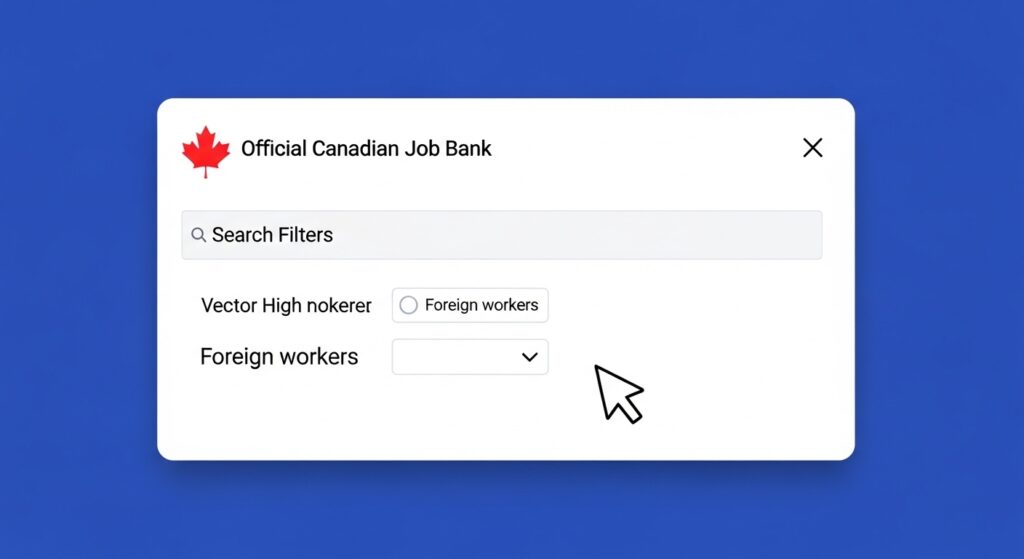
The primary, government-sanctioned platform for locating LMIA-approved positions is the national Job Bank. Managed directly by the federal government, this portal mandates strict employer verification protocols, significantly reducing the risk of fraudulent job offers.
Advanced Search Filters for Foreign Nationals
To effectively utilize the Job Bank from outside Canada, candidates must apply specific search parameters. The platform includes a dedicated filter for "Temporary Foreign Workers." Selecting this filter isolates job postings from employers who have explicitly indicated they possess a valid LMIA or have an LMIA application in progress.
When reviewing a posting, applicants must look for the "Intended job posting audience" section at the bottom of the page. Legitimate opportunities for international applicants will explicitly state: "Other specific audiences: Anyone who can legally work in Canada can apply for this job. If you are not currently authorized to work in Canada, the employer will consider your job application." If this statement is absent, the employer is legally restricted to hiring domestic candidates.
Provincial and Territorial Job Portals
Beyond the federal Job Bank, individual Canadian provinces and territories maintain dedicated employment portals aligned with their specific demographic and industrial needs. These portals often highlight employers seeking foreign talent through employer-driven streams of the Provincial Nominee Programs (PNP).
Navigating Provincial Platforms
Provinces experiencing acute labor shortages frequently publish lists of designated employers or active job vacancies. For example:
- Quebec: Operates under a distinct immigration agreement with the federal government. Employers in Quebec utilize the Ministère de l'Immigration, de la Francisation et de l'Intégration (MIFI) portal to process the provincial equivalent of the LMIA, known as the Certificat d'acceptation du Québec (CAQ) for temporary workers.
- Atlantic Provinces: Employers designated under the Atlantic Immigration Program (AIP) utilize specific provincial registries in Nova Scotia, New Brunswick, Prince Edward Island, and Newfoundland and Labrador. While the AIP is an LMIA-exempt permanent residency pathway, the provincial portals frequently overlap with TFWP recruitment efforts, making them vital resources for locating established, internationally recruiting corporations.
Identifying Legitimate Recruitment Agencies
While direct applications through government portals are the most secure method, many Canadian employers utilize licensed recruitment agencies to source international talent, particularly for high-volume agricultural, manufacturing, and healthcare positions.
Regulatory Compliance for Recruiters
Under Canadian law, foreign workers must not be charged recruitment fees by an agency or an employer for securing a job offer or an LMIA. The employer is strictly and legally responsible for all financial costs associated with the recruitment process, including the $1,000 CAD LMIA processing fee paid to ESDC and any commissions owed to the recruiting firm.
Verifying Recruitment Agencies
Several Canadian provinces have enacted strict legislation requiring employment agencies and foreign worker recruiters to be formally licensed and registered.
- British Columbia: Agencies must be registered under the Temporary Foreign Worker Protection Act.
- Saskatchewan: Employers must hold a Certificate of Registration, and recruiters must be licensed under the Foreign Worker Recruitment and Immigration Services Act.
- Nova Scotia: Employers utilizing the TFWP must obtain an Employer Registration Certificate from the provincial Labour Standards Division.
Candidates utilizing third-party services must verify the agency's license against these provincial public registries to ensure regulatory compliance and avoid exploitation.
Fraud Prevention and Identifying Scam Job Offers
The global demand for Canadian work permits creates an environment highly susceptible to immigration fraud. Foreign nationals must evaluate potential LMIA job offers with extreme scrutiny. The Canada Border Services Agency (CBSA) and IRCC consistently monitor and penalize fraudulent immigration activities.
Recognizing the Warning Signs of Fraud
Official government guidelines outline several definitive indicators of a fraudulent job offer or a fabricated LMIA:
- Requests for Financial Deposits: As previously stated, any demand for the applicant to pay for the LMIA, the job offer, or "administrative processing fees" to the employer is a direct violation of Canadian labor and immigration law.
- Guarantees of Visa Approval: No employer, recruitment consultant, or lawyer can guarantee the approval of a work permit. Only an IRCC officer holds the legal authority to grant temporary resident status and work authorization in Canada.
- Unofficial Communication Protocols: Legitimate Canadian corporations communicate via registered corporate email domains. Offers extending from public, unencrypted email services (e.g., Gmail, Yahoo) or mobile messaging applications (e.g., WhatsApp, Telegram) are highly suspect and often indicate a scam.
- Fabricated LMIA Documents: Scammers frequently forge LMIA approval letters. A genuine LMIA contains a specific seven-digit system file number. Applicants have the right to request a copy of the positive LMIA annex from the employer to verify its authenticity before applying for their work permit.

The Post-LMIA Process: Applying for the Work Permit
Once a legitimate employer with a positive LMIA is identified and a formal job offer is accepted, the administrative process transitions from ESDC jurisdiction to IRCC jurisdiction. The positive LMIA alone does not grant authorization to enter or work in Canada; it is merely the prerequisite document required to file the work permit application.
Required Documentation for IRCC
To apply for an employer-specific (closed) work permit from outside Canada, the foreign national must submit a complete application package to Immigration, Refugees and Citizenship Canada (IRCC), which must include:
- The official, detailed job offer letter signed by both the Canadian employer and the applicant.
- A copy of the positive LMIA document provided by ESDC to the employer.
- The LMIA tracking number, which must be entered directly into the federal work permit application form.
- Proof of qualifications demonstrating that the applicant possesses the exact education, professional certifications, and work experience required for the occupation, as defined by the National Occupational Classification (NOC) system.
- Proof of identity (a valid national passport) and the completion of mandatory biometrics at a designated Visa Application Centre (VAC).
Processing Times and Consular Adjudication
Work permit processing times vary significantly based on the applicant's country of residence and the current volume of applications. Candidates can verify current estimated timelines utilizing the official IRCC Processing Times Tool. Depending on the applicant's nationality, the nature of the employment (e.g., healthcare or agriculture), and the intended duration of stay, an Immigration Medical Exam (IME) conducted by a Panel Physician and police clearance certificates may be mandatorily requested before final adjudication can occur.
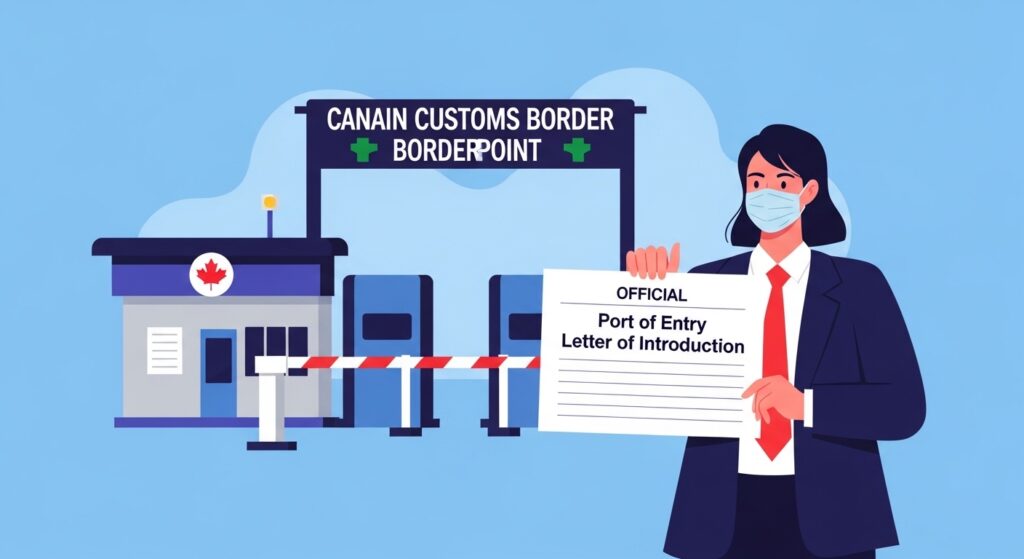
Upon approval of the application, IRCC will issue a Port of Entry (POE) Letter of Introduction to the applicant's online portal. It is critical to note that the actual, physical work permit document is not mailed. It is printed and issued by a CBSA officer only upon the applicant's arrival at a Canadian border crossing or international airport, following a final admissibility inspection to ensure all statutory requirements are still met.
Read more about: [Pathways to Canadian Permanent Residency through the Provincial Nominee Program (PNP)]
Disclaimer: This guide is for informational purposes only and is based on public data available for 2026. Visandwork.com is not a government agency, does not issue visas, and does not provide personalized legal or immigration advice. Always consult official government portals before initiating any application process.