Express Entry vs. Temporary Work Permits in Canada: What to Choose in 2026?
The Canadian immigration framework, managed by Immigration, Refugees and Citizenship Canada (IRCC), offers distinct statutory pathways for foreign nationals seeking to live and work within the country. For economic immigrants, the fundamental decision lies between pursuing immediate, temporary employment authorization or applying directly for permanent residency. In 2026, understanding the structural differences, eligibility requirements, and processing timelines between the Express Entry system and Temporary Work Permits is critical for applicants and sponsoring employers.

The Express Entry System: Permanent Residency Framework
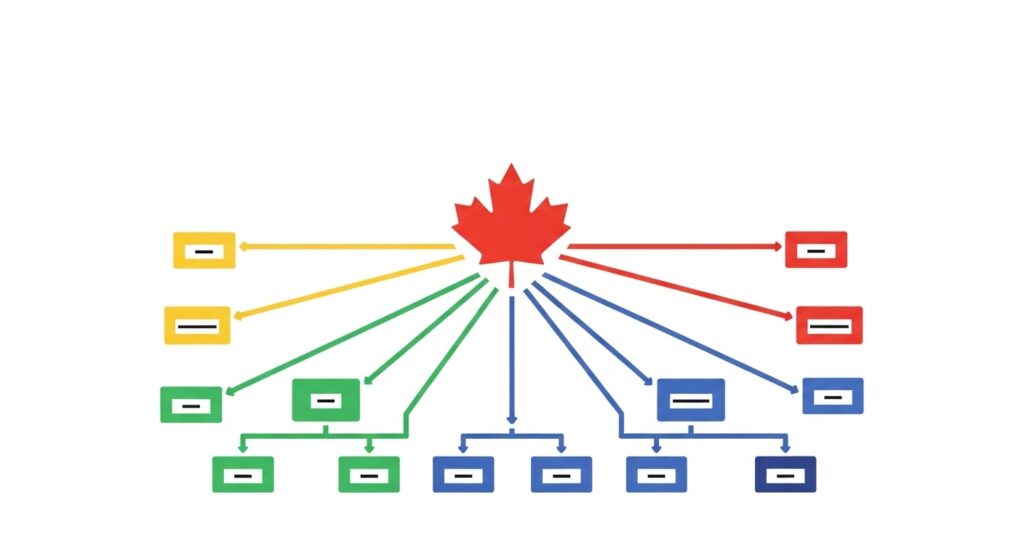
Express Entry is not an immigration program itself; rather, it is the federal government's application management system for processing permanent residence applications under three specific economic immigration programs. Candidates who successfully navigate this system are granted Canadian permanent resident status, allowing them to live, work, and study anywhere in the country without employer restrictions.
Core Economic Class Programs
Foreign nationals must first meet the minimum eligibility criteria for one of the following federal programs to enter the Express Entry pool:
- Federal Skilled Worker Program (FSWP): Designed for foreign workers with professional work experience abroad. Eligibility is calculated on a 100-point grid assessing language proficiency in English or French, education, work experience, age, arranged employment, and adaptability. A minimum score is strictly required to qualify.
- Canadian Experience Class (CEC): Targeted at individuals who have already acquired at least one year of full-time, skilled work experience inside Canada within the three years prior to application.
- Federal Skilled Trades Program (FSTP): Facilitates permanent residency for foreign nationals qualified in a specific skilled trade (e.g., industrial, electrical, construction, and agricultural trades) who hold a valid job offer or a certificate of qualification from a Canadian provincial or territorial authority.
The Comprehensive Ranking System (CRS) and Category-Based Selection
Once in the pool, candidates are ranked using the Comprehensive Ranking System (CRS). This automated, points-based system awards a maximum of 1,200 points based on core human capital factors, skill transferability, and additional factors such as a provincial nomination or a valid arranged employment offer.
In recent years, IRCC has heavily utilized Category-Based Selection rounds of invitations. Rather than purely selecting the highest overall CRS scores, the government targets candidates with specific occupational experience (such as healthcare, STEM, trades, transport, and agriculture) or strong French-language proficiency to address acute demographic and regional labor market shortages.
Temporary Work Permits: Immediate Labor Market Entry
Unlike Express Entry, a temporary work permit authorizes a foreign national to work in Canada for a finite, specified period. These permits do not automatically grant permanent resident status, though the Canadian work experience gained is often utilized later to qualify for the CEC under Express Entry. Work permits are divided into two primary regulatory frameworks.
The Temporary Foreign Worker Program (TFWP) and LMIAs
The TFWP allows Canadian employers to hire foreign workers to fill temporary labor and skill shortages when qualified Canadian citizens or permanent residents are demonstrably unavailable. The defining characteristic of the TFWP is the requirement for a Labour Market Impact Assessment (LMIA).
Administered by Employment and Social Development Canada (ESDC), an LMIA is a rigorous administrative document an employer must secure before the foreign national can apply for a work permit. To obtain a positive LMIA, the employer must demonstrate extensive domestic recruitment efforts, prove that hiring a foreign worker will not negatively impact the Canadian labor market, and guarantee that the worker will receive the prevailing wage for the specific occupation and geographic location. Work permits issued under the TFWP are strictly "employer-specific" (closed), meaning the foreign national is legally authorized to work only for the employer named on the permit, at the specified physical location, and in the designated occupational classification.
The International Mobility Program (IMP)
The International Mobility Program operates entirely independently of the LMIA process. It allows employers to hire temporary foreign workers without an LMIA if the employment advances Canada's broad economic, cultural, or competitive interests. The IMP includes several distinct categories based on bilateral agreements, reciprocal employment, and significant benefit to Canadians. One of the most utilized pathways within the IMP is the Intra-Company Transfer (ICT) program, which enables multinational corporations to temporarily relocate qualified employees to Canadian branches, subsidiaries, or affiliates. Other significant IMP streams include the Francophone Mobility program and various Free Trade Agreement (FTA) professionals categories, such as those established under the Canada-United States-Mexico Agreement (CUSMA).
Transitioning from Temporary to Permanent Status
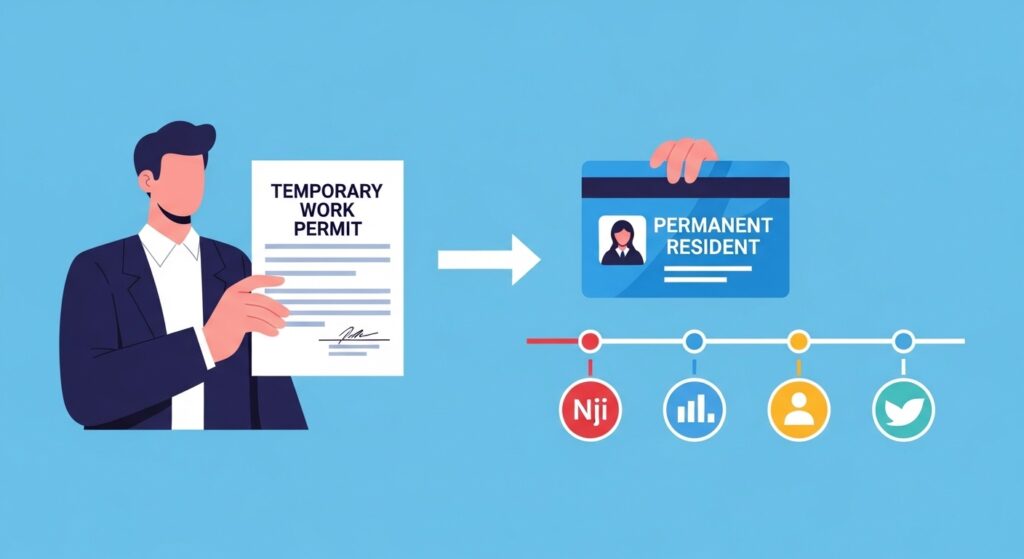
A strategic consideration for many foreign nationals is utilizing a temporary work permit as a direct stepping stone to permanent residency. Canadian immigration policy structurally incentivizes this transition, recognizing the integration and economic contributions of temporary workers.
The Canadian Experience Class (CEC) Advantage
As previously noted, the CEC is specifically designed for temporary foreign workers. Accumulating 12 months of full-time, skilled work experience in Canada (classified under National Occupational Classification (NOC) Training, Education, Experience and Responsibilities (TEER) categories 0, 1, 2, or 3) satisfies the primary eligibility requirement for this program. Work experience gained while under a valid temporary work permit significantly boosts a candidate's CRS score within the Express Entry pool, thereby increasing the statistical probability of receiving an Invitation to Apply (ITA) for permanent residence.
Bridging Open Work Permits (BOWP)
A critical mechanism for individuals transitioning between temporary and permanent status is the Bridging Open Work Permit (BOWP). If a foreign national is currently in Canada on a valid work permit, has submitted a complete application for permanent residence under Express Entry, and their current permit is within four months of expiration, they may apply for a BOWP. This specialized open work permit allows the applicant to maintain legal employment status and work for any employer in Canada while IRCC processes their permanent residency application, preventing abrupt employment termination.
Dual Intent: Managing Both Pathways Simultaneously
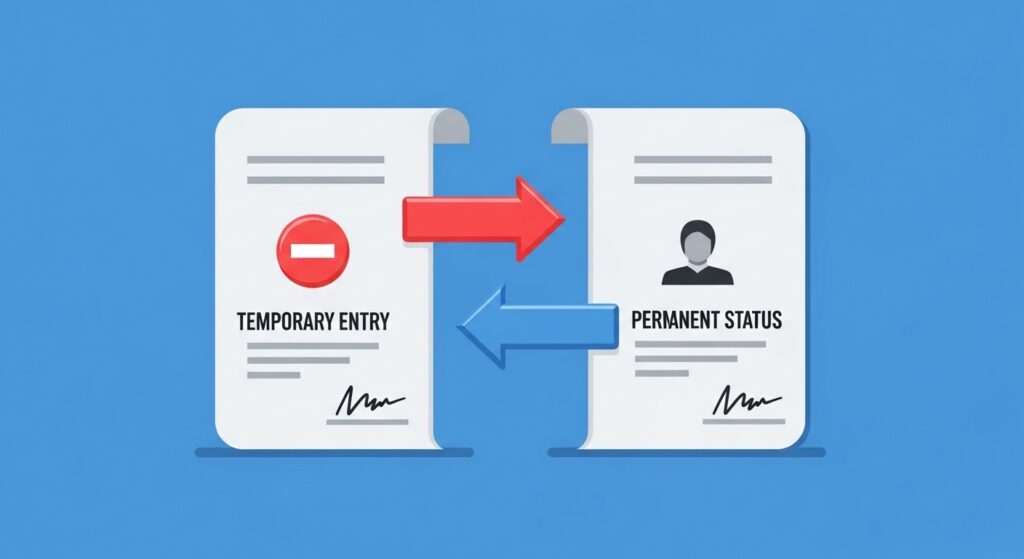
Canadian immigration law explicitly recognizes the concept of "dual intent." According to the Immigration and Refugee Protection Act (IRPA), an intention by a foreign national to become a permanent resident does not preclude them from becoming a temporary resident if the officer is satisfied that they will leave Canada by the end of the period authorized for their stay.
Strategic Implementation of Dual Intent
This statutory provision permits an applicant to pursue an Express Entry profile concurrently with a temporary work permit application.
- An employer may initiate an LMIA process and subsequent work permit application to facilitate the immediate onboarding of a foreign worker.
- Simultaneously, the worker can enter the Express Entry pool.
- The foreign worker must demonstrate to the border services officer at the port of entry that, despite their long-term permanent residency goals, they will comply with the temporary restrictions of the work permit and depart Canada if permanent residency is not granted before the permit expires.
Processing Times and Cost Considerations
The operational mechanics of both systems dictate different financial and temporal commitments from both the applicant and the sponsoring employer. Processing times fluctuate continuously based on IRCC application inventories and global events, and exact times must be verified directly through the official IRCC Processing Times Tool.
Express Entry Timelines and Fees
- Processing Standard: IRCC maintains a stated standard of processing 80% of Express Entry applications within six months from the date a complete application is received following an ITA.
- Financial Commitment: The Express Entry process involves substantial upfront costs, including language testing, Educational Credential Assessments (ECA), application processing fees, and the Right of Permanent Residence Fee (RPRF). Furthermore, FSWP and FSTP candidates without a valid job offer must demonstrate proof of settlement funds to support themselves and their accompanying family members.
Temporary Work Permit Timelines and Fees
- Processing Standard: Processing times for work permits vary significantly depending on the applicant's country of residence and whether the application is submitted online or at a Visa Application Centre (VAC). Applications filed from within Canada typically experience shorter processing times than those filed overseas. Additionally, the LMIA process adds considerable time (frequently 2 to 4 months) before the work permit application can even be submitted by the foreign worker.
- Financial Commitment: The primary financial burden for the TFWP falls on the employer, who must pay the mandatory $1,000 CAD LMIA processing fee per requested position. The foreign worker is responsible for the standard work permit processing fee ($155 CAD) and biometrics fees.
Administrative Review and Program Integrity
Both the Express Entry system and the Temporary Work Permit programs are subject to rigorous administrative review to ensure program integrity and prevent fraud. IRCC officers and Canada Border Services Agency (CBSA) officials conduct extensive background checks, security screenings, and medical examinations for all applicants. Misrepresentation of material facts, including falsified work experience or undisclosed medical conditions, results in immediate application refusal and a potential five-year ban from entering Canada under section 40 of the IRPA.
Employers participating in the TFWP and IMP are also subject to employer compliance inspections. ESDC investigates employers to ensure they are fulfilling the conditions outlined in the LMIA or the IMP offer of employment, including paying the stipulated wages and providing the agreed-upon working conditions. Non-compliant employers face administrative monetary penalties (AMPs), bans from hiring foreign workers, and the potential revocation of previously approved LMIAs.
Read more about: [Canadian Provincial Nominee Programs (PNP) and Regional Labor Demands]
Disclaimer: This guide is for informational purposes only and is based on public data available for 2026. Visandwork.com is not a government agency, does not issue visas, and does not provide personalized legal or immigration advice. Always consult official government portals before initiating any application process.