Canadian Work Visas for Entry-Level and Seasonal Roles (2026)
The Canadian economy relies structurally on temporary foreign workers to sustain operations in sectors characterized by pronounced seasonal fluctuations or persistent entry-level labor shortages. Immigration, Refugees and Citizenship Canada (IRCC) and Employment and Social Development Canada (ESDC) manage specific regulatory pathways designed to fill these vacancies. Unlike federal economic immigration programs that prioritize highly educated professionals, these specific streams target occupations classified under National Occupational Classification (NOC) TEER 4 and TEER 5. This document details the statutory requirements, programmatic frameworks, and employer obligations governing entry-level and seasonal work visas in 2026.

The Temporary Foreign Worker Program (TFWP) Framework
The primary mechanism for hiring foreign nationals for entry-level and seasonal positions is the Temporary Foreign Worker Program (TFWP), administered by ESDC. The defining characteristic of the TFWP is the requirement for a Labour Market Impact Assessment (LMIA).
The LMIA Requirement for Employers
Foreign workers cannot self-petition for an entry-level work permit. A Canadian employer must initiate the process by applying for an LMIA. The employer is legally obligated to demonstrate that exhaustive efforts to recruit Canadian citizens or permanent residents were unsuccessful. ESDC requires documented proof of continuous domestic advertising across specific government and commercial job boards for a minimum of four weeks prior to the LMIA submission. For entry-level positions, ESDC heavily scrutinizes these applications to ensure that the importation of foreign labor does not depress regional wage standards or working conditions.
The Seasonal Agricultural Worker Program (SAWP)
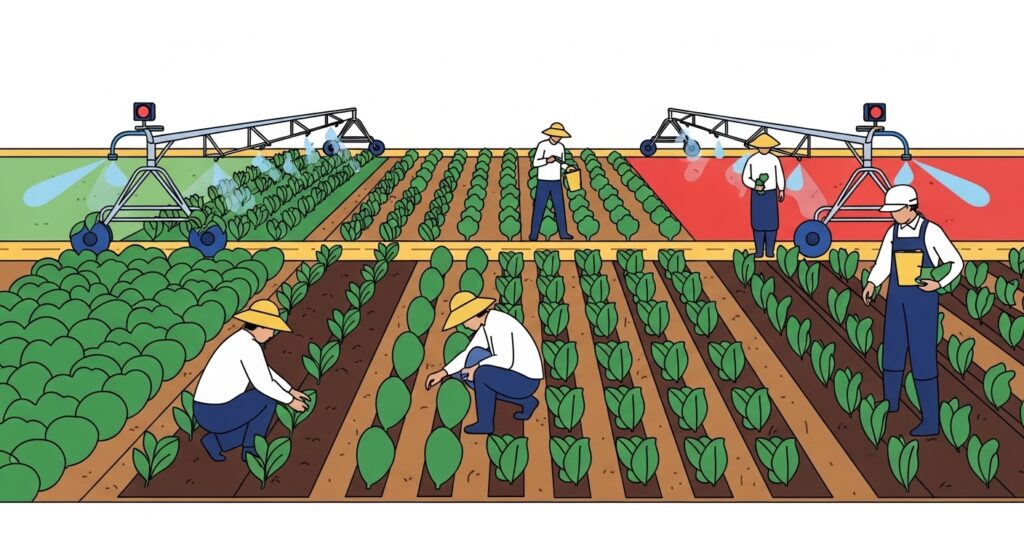
The Seasonal Agricultural Worker Program (SAWP) is the most utilized pathway for seasonal labor in Canada. It operates under bilateral agreements between Canada and specific participating countries.
Participating Nations and Eligible Sectors
The SAWP is exclusively available to citizens of Mexico and participating Caribbean countries (including Jamaica, Barbados, Trinidad and Tobago, and the Organization of Eastern Caribbean States). The program is strictly limited to primary agriculture.
- Eligible Commodities: The work must involve specific agricultural commodities, including apiary products, fruits, vegetables, mushrooms, flowers, nursery-grown trees, and greenhouse crops.
- Permit Duration: Work permits issued under the SAWP are strictly employer-specific (closed) and are valid for a maximum duration of eight months between January 1 and December 15 of the calendar year. Workers must return to their home country at the conclusion of the approved period.
Statutory Employer Obligations Under SAWP
To prevent exploitation and ensure standard living conditions, ESDC enforces rigorous operational mandates on Canadian employers participating in the SAWP.
- Housing: Employers must provide free, adequate housing that passes physical inspections conducted by provincial or municipal health authorities prior to the arrival of the foreign workers.
- Transportation: The employer is legally responsible for paying the round-trip international airfare from the worker's home country to the Canadian work location. These costs cannot be recovered through payroll deductions.
- Health Insurance: Employers must ensure workers are registered for provincial health insurance or provide equivalent private health coverage at the employer's expense until the provincial coverage activates.
The Primary Agriculture Stream
For foreign nationals who are citizens of countries not included in the SAWP bilateral agreements, employers utilize the general Primary Agriculture Stream.
Operational Differences from SAWP
While the Primary Agriculture Stream shares the SAWP's focus on farming and crop production, it operates with distinct administrative requirements.
- Duration: Work permits under this stream can be issued for up to 24 months, accommodating non-seasonal agricultural operations such as year-round livestock, dairy, and poultry farming.
- Housing and Transportation: Similar to the SAWP, employers must provide adequate housing. However, under this stream, employers can charge a strictly regulated, maximum weekly deduction for accommodations (excluding British Columbia, where specific provincial regulations prohibit such deductions for agricultural workers). Employers must also pay for the worker's round-trip transportation.
The Low-Wage Stream for Entry-Level Roles
Outside of primary agriculture, employers in sectors such as hospitality, food and beverage processing, and retail utilize the TFWP's Low-Wage Stream to fill TEER 4 and TEER 5 entry-level positions.
Definition of Low-Wage
A position is classified under the Low-Wage stream if the offered wage is below the provincial or territorial median hourly wage, which is calculated and updated annually by Statistics Canada and published on the federal Job Bank. Employers must guarantee the foreign worker either the provincial median wage for the specific occupation or the rate paid to domestic employees in the same role at that location, whichever is higher.
Cap on Proportion of Low-Wage Workers
To protect the domestic workforce, ESDC imposes a strict cap on the number of low-wage temporary foreign workers a business can employ. Generally, employers are restricted to a 20% cap. This means that a maximum of 20% of an employer's total workforce at a specific physical location can consist of temporary foreign workers hired under the Low-Wage stream. In certain regions experiencing unemployment rates above 6%, ESDC may refuse to process LMIAs for specific entry-level occupations entirely, particularly in the accommodations and food services sectors, to mandate the hiring of local residents.
Mandated Employer Requirements for Low-Wage Workers
The administrative burden on employers utilizing the Low-Wage stream is substantial, reflecting the government's mandate to protect vulnerable workers in entry-level positions.
- Return Transportation: The employer must pay for the foreign worker's round-trip transportation costs.
- Housing Availability: The employer must ensure that suitable, affordable housing is available for the temporary foreign worker. While the employer is not legally required to pay for the housing, they must prove they have assisted the worker in securing a lease or accommodations that do not exceed 30% of the worker's gross income.
- Health Coverage: The employer must pay for private health insurance covering emergency medical care during the waiting period before the worker becomes eligible for the provincial or territorial public health insurance system.

The Agri-Food Pilot: A Pathway to Permanent Residency
Historically, entry-level and seasonal work permits provided no structured pathway to permanent Canadian residency. The temporary nature of the permits required workers to return home once their contracts expired. To address chronic, year-round labor shortages in specific agricultural sectors, IRCC launched the Agri-Food Pilot.
Eligibility and Target Occupations
The Agri-Food Pilot is an industry-specific immigration program designed to transition experienced, non-seasonal temporary agricultural workers into permanent residents. The pilot strictly targets specific occupations within the meat processing, greenhouse, nursery, and mushroom production industries. Eligible NOC codes generally include:
- Retail butchers (NOC 63201)
- Industrial butchers and meat cutters (NOC 94141)
- Food processing labourers (NOC 95106)
- General farm workers (NOC 84120) focusing on year-round greenhouse crop production or livestock.
- Harvesting labourers (NOC 85101) specializing in year-round mushroom production.
Work Experience and Educational Requirements
To qualify for permanent residency under this pilot, applicants must accumulate at least 12 months of full-time, non-seasonal Canadian work experience in one of the eligible occupations. This experience must be acquired while holding a valid work permit supported by an LMIA. Furthermore, applicants must meet specific language requirements (Canadian Language Benchmark Level 4 in English or French) and possess a Canadian high school diploma or an Educational Credential Assessment (ECA) demonstrating the foreign equivalent.
Application Mechanics for the Foreign National
Once a Canadian employer secures a positive LMIA, the administrative responsibility shifts to the foreign national to apply for the actual work permit through IRCC.
Document Preparation and Submission
Foreign nationals must submit an employer-specific work permit application. The application requires the formal job offer letter, the LMIA approval number, and proof that the applicant meets the exact requirements of the job as outlined in the NOC classification. Due to the physical nature of entry-level and agricultural work, applications are heavily scrutinized for past employment verification.
Biometrics and Medical Examinations
Citizens of most countries are mandatorily required to provide biometrics (fingerprints and a digital photograph) at an authorized Visa Application Centre (VAC) or Application Support Center (ASC). Furthermore, because agricultural, food processing, and hospitality roles involve close contact with the public or agricultural products, applicants must undergo an Immigration Medical Examination (IME). This examination must be conducted by an IRCC-approved Panel Physician in the applicant's home country to ensure they do not pose a danger to public health or public safety.
Port of Entry (POE) Procedures and Admissibility
Following the approval of the work permit application by IRCC, the foreign national does not receive the physical work permit document by mail. Instead, IRCC issues a Port of Entry (POE) Letter of Introduction. The actual work permit is printed and issued by a Canada Border Services Agency (CBSA) officer upon arrival at a Canadian port of entry.
The CBSA officer conducts a final admissibility inspection to ensure the foreign worker meets all statutory requirements before granting entry. The foreign national must present:
- A valid passport or travel document.
- The official POE Letter of Introduction.
- A physical copy of the employer's positive LMIA and the signed formal job offer.
- Proof of sufficient financial funds to support themselves upon initial arrival, unless the employer is contractually providing housing and return transportation, as mandated in the SAWP.

Worker Rights and Protections in Canada
Canadian labor law strictly mandates that temporary foreign workers possess the exact same workplace rights and protections as Canadian citizens and permanent residents. Provincial employment standards ministries enforce regulations regarding minimum wage compliance, overtime pay calculations, maximum working hours, and occupational workplace safety protocols.
The Open Work Permit for Vulnerable Workers
To structurally prevent the exploitation of foreign nationals holding employer-specific (closed) work permits, IRCC established the Open Work Permit for Vulnerable Workers (OWP-V).
- If a foreign worker is experiencing physical, psychological, sexual, or financial abuse in the workplace, they are eligible to apply for an OWP-V.
- This specialized permit is generally prioritized and issued swiftly, allowing the worker to legally and immediately leave the abusive employer and seek employment with almost any other employer in Canada.
- There is no IRCC application fee for the OWP-V, and the applicant is not required to secure a new LMIA to transition to a compliant employment environment.
Employer Compliance and Inspections
The federal government maintains a rigorous, continuous employer compliance regime to protect the integrity of the TFWP. ESDC frequently conducts unannounced, on-site administrative inspections of agricultural farms, processing plants, and hospitality venues employing temporary foreign workers.
Inspectors rigorously verify that employers are adhering to the exact conditions stipulated in the approved LMIA, including verified wage rates, accurate job duties, and the condition of employer-provided housing. Employers found non-compliant face severe administrative monetary penalties (AMPs), the immediate revocation of all existing LMIAs, and permanent bans from utilizing federal immigration programs. Non-compliant employers are subsequently published on the public IRCC employer non-compliance registry.

Provincial Nominee Programs (PNP) for Semi-Skilled Workers
While federal economic programs, such as those managed under the Express Entry system, are heavily weighted toward TEER 0, 1, 2, and 3 occupations, several provincial governments have recognized the permanent nature of entry-level labor shortages within their jurisdictions. Consequently, they have established dedicated Provincial Nominee Program (PNP) pathways specifically for TEER 4 and TEER 5 workers.
Regional Pathways to Permanent Residency
Provinces experiencing rapid industrial expansion or high-volume hospitality growth offer specific immigration streams allowing temporary foreign workers to transition to permanent residency:
- British Columbia PNP (Entry Level and Semi-Skilled): Designed specifically for workers in the tourism, hospitality, food processing, and long-haul trucking sectors who have been employed full-time by an eligible BC employer for at least nine consecutive months.
- Alberta Advantage Immigration Program (AAIP): The Tourism and Hospitality Stream targets workers already employed full-time within the province in specific service sectors, requiring the applicant to hold a valid LMIA-based work permit at the time of application.
- Saskatchewan Immigrant Nominee Program (SINP): The Hard-to-Fill Skills Pilot allows provincial employers to recruit international workers for intermediate and low-skilled jobs that demonstrate persistent, documented recruitment challenges.
These provincial programs generally require the applicant to hold a permanent, full-time job offer from an eligible, registered provincial employer. Furthermore, applicants must typically possess basic English or French language proficiency (a minimum of Canadian Language Benchmark Level 4) and have completed a recognized minimum level of secondary education.
Read more about: [Canadian Open Work Permits for Vulnerable Workers and Abuse Prevention]
Disclaimer: This guide is for informational purposes only and is based on public data available for 2026. Visandwork.com is not a government agency, does not issue visas, and does not provide personalized legal or immigration advice. Always consult official government portals before initiating any application process.