Avoiding Common Pitfalls in the Spanish Work Visa Application
The Spanish immigration system is governed by a strict statutory framework, primarily dictated by the General Immigration Law (Ley de Extranjería) and the Entrepreneurs Act (Ley de Apoyo a los Emprendedores y su Internacionalización). Processing applications for third-country nationals involves coordinated oversight by the Ministry of Inclusion, Social Security and Migration and the Ministry of Foreign Affairs. Due to the exact administrative standards required by these federal bodies, procedural anomalies frequently result in processing delays, requests for supplementary documentation (requerimientos), or definitive visa refusals. This document identifies the structural errors commonly committed during the Spanish employment visa application process and details the regulatory compliance required to prevent them.
Deficiencies in the National Employment Situation Test
For traditional residence and work permits as an employee (Autorización de residencia y trabajo por cuenta ajena), the most prevalent point of failure occurs prior to the individual visa application. The sponsoring Spanish employer is legally obligated to pass the National Employment Situation test (Situación Nacional de Empleo).
Skipping the SEPE Verification
Employers frequently attempt to submit an initial work authorization request without first advertising the vacancy through the State Public Employment Service (SEPE). Spanish law dictates that the position must be offered to the domestic workforce, EU nationals, and legal residents registered as unemployed. An application will be summarily rejected if the employer fails to provide a negative certificate from SEPE proving that no suitable domestic candidate was available.
- Exceptions: This requirement is only waived if the occupation is explicitly listed on the quarterly Shortage Occupation List (Catálogo de Ocupaciones de Difícil Cobertura) or if the applicant qualifies for specific exemptions, such as being a family member of a legal resident or holding specific regional ties.

Credential Verification and Legalization Errors
The Spanish administrative system demands absolute authenticity of all foreign civil and academic documents. Submitting unauthenticated vital records or unverified university degrees guarantees an administrative refusal.
The Hague Apostille and Diplomatic Legalization
A systemic error is submitting foreign marriage certificates, birth certificates, or police clearance records without international authentication. Documents issued outside of Spain must bear the Hague Apostille if the issuing country is a signatory to the 1961 Hague Convention. If the country is not a signatory, the documents must undergo a formalized chain of diplomatic legalization through the Spanish consulate in the country of origin.
- Certified Translations: Furthermore, any document not originally drafted in Spanish must be translated by a sworn translator (Traductor Jurado) officially registered with the Spanish Ministry of Foreign Affairs. Commercial translations or self-translated documents possess zero legal validity.
Homologación vs. Equivalencia
For Highly Qualified Professional (PAC) visas or roles in regulated professions (such as medicine or engineering), applicants often submit foreign university degrees without obtaining formal Spanish recognition. Depending on the profession, applicants must secure either a formal Homologación (granting the right to practice a regulated profession) or an Equivalencia (certifying academic level parity) from the Ministry of Universities. Filing the visa application while these verifications are still pending frequently leads to case archiving.
Misunderstanding the Digital Nomad Visa Income Thresholds
The International Teleworker Visa, established under the Startup Law, shifts the burden of proof from a Spanish employer directly onto the foreign remote worker. Applications processed by the Large Companies and Strategic Collectives Unit (UGE-CE) strictly evaluate financial solvency.
The SMI Multiplier Failure
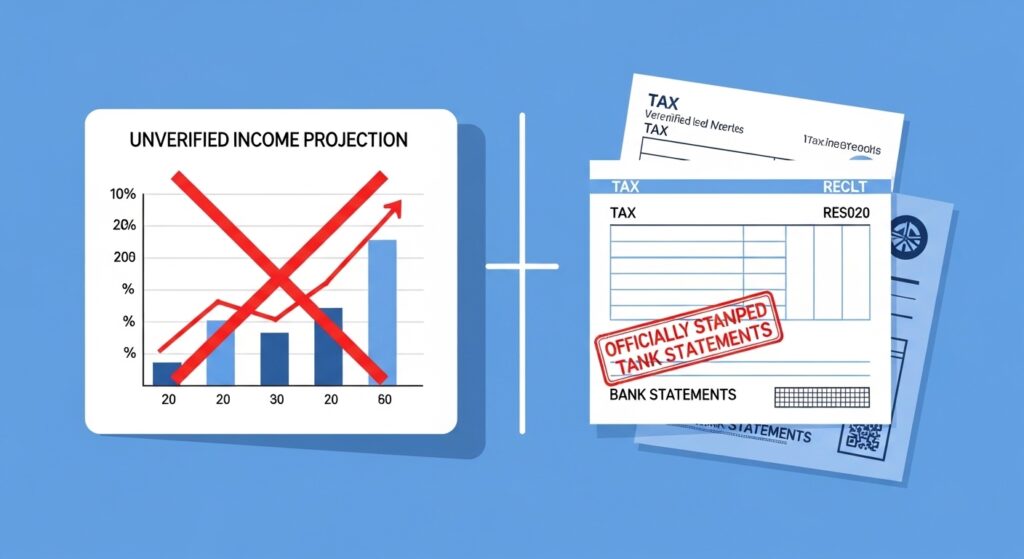
The statutory requirement dictates that the applicant must prove a continuous monthly income equal to 200% of the Spanish Minimum Interprofessional Wage (SMI). A common pitfall is calculating this threshold using gross annual revenue projections or anticipated freelance contracts. The UGE-CE requires verifiable historical data—specifically, bank statements and tax returns from the preceding three months—proving the net income has consistently met the 200% threshold.
Procedural Timing and Jurisdiction Errors
Navigating the dual pathways of consular processing versus in-country applications causes significant compliance failures.
Invalid In-Country Applications
A pervasive error occurs when a foreign national enters Spain on a 90-day Schengen tourist visa waiver with the intent to apply for a standard Cuenta Ajena work permit. Under the General Immigration Law, standard employment authorizations must be initiated by the employer in Spain, but the foreign worker must apply for the physical visa at the Spanish consulate in their country of origin or legal residence. Attempting to circumvent consular processing by applying from within Spain results in automatic denial and potential administrative penalties for overstaying the tourist waiver.
The 60-Day Renewal Window
For foreign nationals already legally residing in Spain under a different permit (such as a student visa) seeking to modify their status to a work permit, strict statutory deadlines apply. The modification application must be submitted within the 60 calendar days prior to the expiration of the current Residence Identification Card (TIE), or within the 90 days following its expiration. Failing to file within this precise window extinguishes the right to modify the permit, forcing the applicant to restart the entire process from their home country.
Social Security and Identity Card (TIE) Failures
Receiving the visa stamp in a passport does not conclude the legal integration process. Significant pitfalls occur during the transition from the entry visa to domestic administrative registration.
Delayed Social Security Registration
Upon arrival in Spain with a traditional work visa, the sponsoring employer must register the foreign national with the General Treasury of the Social Security (Tesorería General de la Seguridad Social). This registration (Alta) must occur before the employee commences any labor activity. If an employer delays this registration, or if a Digital Nomad fails to register themselves under the Special Regime for Self-Employed Workers (RETA) promptly, the underlying work authorization is structurally invalidated.
Missing the 30-Day TIE Deadline
Under Spanish immigration law, foreign nationals holding visas valid for more than six months are legally mandated to apply for their physical Foreigner Identity Card (Tarjeta de Identidad de Extranjero - TIE). The pitfall occurs when applicants fail to secure a prior appointment (Cita Previa) at the National Police station (Comisaría de Policía Nacional) within 30 days of their legal entry into the Schengen Area.

Furthermore, applicants routinely arrive at their TIE fingerprinting appointments lacking the mandatory Certificate of Municipal Registration (Certificado de Empadronamiento). This certificate, obtained from the local town hall (Ayuntamiento), is a strict prerequisite for TIE issuance. Failing to register a residential address immediately upon arrival paralyzes the TIE process, leaving the foreign national without physical proof of their residency status.
Submitting Applications to Incorrect Jurisdictions
Spain’s decentralized administrative structure means that immigration competencies are distributed across different federal and provincial bodies. Filing an application with the incorrect governmental entity results in the application being archived for lack of jurisdiction (inadmisión a trámite).
Provincial Immigration Offices vs. UGE-CE
Applications for standard Cuenta Ajena work permits and local modifications must be directed to the specific Provincial Immigration Office (Oficina de Extranjería) where the Spanish employer is legally registered or where the work will primarily be executed. Conversely, applications governed by the Entrepreneurs Act, including the Highly Qualified Professional (PAC), Intra-Corporate Transfer (ICT), and Digital Nomad visas, must be submitted electronically to the centralized Large Companies and Strategic Collectives Unit (UGE-CE) in Madrid. Directing a Digital Nomad application to a provincial office, or a standard employment application to the UGE-CE, guarantees immediate administrative rejection.
Financial Solvency and Bank Statement Errors
For visas requiring proof of financial solvency independent of a Spanish employment contract (such as the Digital Nomad Visa or entrepreneurial permits), the Ministry of Inclusion, Social Security and Migration dictates exact evidentiary standards for financial records.
Unverifiable Foreign Capital
Applicants frequently submit screenshots of cryptocurrency portfolios, uncertified printouts from online investment platforms, or letters from foreign accountants to prove solvency. Spanish authorities generally reject these formats. Financial solvency must be proven via official, stamped bank statements spanning a minimum of the preceding three to six months. If the funds are held in a foreign banking institution, the statements must clearly identify the account holder, the current balance, and be accompanied by a sworn translation into Spanish if the original documents are in another language.

Failure to Maintain Visa Conditions for Renewal
A final, critical pitfall occurs not during the initial application, but at the point of permit renewal. Spanish residence and work authorizations are granted based on specific conditions; altering those conditions without prior state authorization nullifies the permit.
Unauthorized Employment Changes
For standard traditional work permits, the initial authorization is strictly bound to the specific sponsoring employer, the specific occupation, and the geographical province for the first year. If the foreign worker terminates their employment, changes industries, or moves to a different province without securing a formal modification from the Immigration Office, their subsequent application for visa renewal will be denied based on non-compliance with the initial authorization parameters.
Tax and Social Security Debts
The renewal of any Spanish residence and work permit is strictly contingent upon the applicant demonstrating full compliance with their fiscal obligations. The adjudicating authorities will automatically query the databases of the Spanish Tax Agency (Agencia Tributaria) and the Social Security Treasury. The existence of any outstanding tax debts, unpaid traffic fines, or arrears in autonomous Social Security quotas (cuotas de autónomo) constitutes immediate grounds for the refusal of a visa renewal.
Read more about: [Spanish Golden Visa: Real Estate Investment Thresholds and Policy Changes]
Disclaimer: This guide is for informational purposes only and is based on public data available for 2026. Visandwork.com is not a government agency, does not issue visas, and does not provide personalized legal or immigration advice. Always consult official government portals before initiating any application process.