Applying for U.S. Jobs from Abroad: Legitimate Portals and Employer Sponsorship
The process of securing employment in the United States as a foreign national requires navigating a complex, highly regulated statutory framework managed primarily by U.S. Citizenship and Immigration Services (USCIS) and the U.S. Department of Labor (DOL). Unlike standard domestic job searches, applying from abroad necessitates identifying employers willing and legally authorized to sponsor employment-based visas. This document outlines the official mechanisms, verified portals, and administrative requirements for identifying legitimate U.S. employment opportunities.
Government-Sanctioned and Verified Job Portals
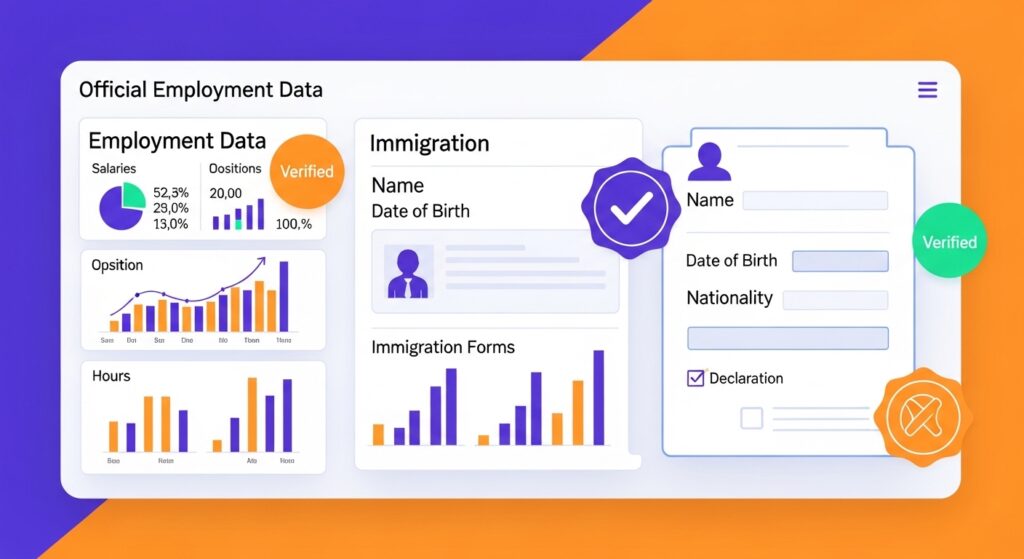
Foreign workers must utilize vetted platforms to minimize exposure to fraudulent offers. While the U.S. government does not operate a universal job board for private-sector visa sponsorship, specific federal portals exist for targeted visa categories, and certain private platforms enforce strict employer verification protocols.
The Seasonal Jobs Portal (H-2A and H-2B Visas)
For individuals seeking temporary agricultural (H-2A) or non-agricultural (H-2B) work, the Department of Labor operates the official Seasonal Jobs registry (SeasonalJobs.dol.gov). This portal lists temporary positions certified by the DOL.
- Employers listed on this site have received an approved temporary labor certification.
- Available positions clearly state the prevailing wage, housing provisions, and exact contract durations.
- Workers can search by state, crop, or industry classification.
E-Verify and Employer Verification
When evaluating private-sector opportunities, candidates should cross-reference potential employers with the E-Verify database. Administered by the Social Security Administration (SSA) and USCIS, E-Verify (E-Verify.gov) is a web-based system that allows enrolled employers to confirm the eligibility of their employees to work in the United States. While E-Verify enrollment is generally voluntary at the federal level, many states and federal contractors mandate its use. Employers utilizing E-Verify demonstrate a documented commitment to legal employment practices and maintain verified federal tax identification numbers.
The Mechanics of Employer Sponsorship
Obtaining a U.S. job offer is only the preliminary step. The employer must formally petition the U.S. government on behalf of the foreign worker. The specific administrative process depends entirely on the requested visa classification (e.g., H-1B, L-1, O-1, or EB-series permanent residency).
Labor Condition Application (LCA) and Prevailing Wage
For the most common specialty occupation visa (H-1B), employers must file a Labor Condition Application with the DOL's Office of Foreign Labor Certification (OFLC). The employer is legally bound to attest to specific and highly regulated labor conditions:
- The foreign worker will be paid the prevailing wage for the occupation in the specific geographic area, or the actual wage paid to similarly employed U.S. workers, whichever is higher.
- The employment will not adversely affect the working conditions of similarly employed U.S. workers.
- There is no current strike or lockout in the occupational classification at the designated place of employment.
Permanent Labor Certification (PERM)
For employment-based permanent residency (Green Cards), employers typically must complete the PERM process. This rigorous procedure requires the employer to conduct specific recruitment activities across multiple mediums to prove that there are no able, willing, qualified, and available U.S. workers for the position. Detailed regulations regarding PERM recruitment are published directly in the Code of Federal Regulations (CFR).
Identifying Sponsoring Employers Structurally
Candidates often waste resources applying to companies that maintain strict internal policies against visa sponsorship. A targeted approach involves identifying organizations with a documented history of filing successful immigration petitions.
The H-1B Employer Data Hub
To identify historical sponsorship patterns, candidates must consult the official USCIS H-1B Employer Data Hub (USCIS H-1B Data Hub). This public database provides transparency into the employment-based immigration system. Users can query the database by:
- Employer Name
- Fiscal Year
- NAICS (North American Industry Classification System) Code
- State, City, or ZIP Code
By analyzing this data, foreign professionals can build lists of high-probability target employers. If an organization has filed hundreds of initial approvals in the preceding fiscal year, they inherently possess the legal infrastructure, dedicated human resources personnel, and retained immigration counsel necessary to support high-volume visa filings. Companies with consistent approval records are significantly more likely to consider international applicants compared to entities with no prior sponsorship history. Additionally, the DOL's Foreign Labor Certification Data Center (FLCDataCenter.com) publishes quarterly disclosure files containing raw data on all PERM and LCA applications. Analysts and job seekers use this data to verify if a specific employer is actively recruiting foreign labor for particular roles.
Utilizing Direct Corporate Portals
Once high-probability employers are identified, candidates must bypass third-party aggregators and apply directly through the official corporate career portals.
Applicant Tracking Systems (ATS) Optimization
Large U.S. employers universally utilize Applicant Tracking Systems (e.g., Workday, Taleo, Greenhouse). To successfully navigate these systems:
- Resumes must be formatted in standard chronological order without complex graphical elements that ATS software cannot parse.
- The documentation must align with standard U.S. formats (excluding personal photographs, date of birth, or marital status, which are restricted under Equal Employment Opportunity Commission (EEOC) guidelines).
- Applicants must accurately answer standard pre-screening questions regarding their current and future need for immigration sponsorship. Misrepresenting the need for sponsorship typically results in immediate disqualification and a permanent ban from applying to that organization.

Working with Specialized Recruitment Agencies
Executive search firms and specialized recruitment agencies occasionally facilitate international hiring, particularly for senior executives or highly specialized technical roles in STEM fields.
Regulatory Compliance for Recruiters
Under U.S. federal law and DOL regulations, the employer—not the employee—must bear the primary costs associated with the recruitment process and the filing of the H-1B petition, including the training fee and the fraud prevention and detection fee.
- Legitimate recruitment agencies are compensated directly by the hiring employer.
- The temporary worker programs, specifically the H-2B visa, strictly prohibit recruiters from charging workers placement fees. The Department of State (Travel.State.gov) and DOL maintain strict enforcement operations against agencies violating these provisions, leading to the debarment of participating employers.
Identifying and Avoiding Employment Fraud
The complexity of the U.S. immigration system makes foreign nationals highly vulnerable to employment scams. The Federal Trade Commission (FTC) and U.S. Immigration and Customs Enforcement (ICE) actively monitor and prosecute visa fraud.
Recognizing Red Flags
Official government guidelines indicate several critical warning signs of fraudulent job offers:
- Requests for Payment: Any request for the applicant to pay for the visa petition, the job offer, or administrative processing fees is a direct violation of U.S. labor laws for most non-immigrant employment categories.
- Guaranteed Visa Approvals: No employer or agency can guarantee a visa approval. The final adjudication rests exclusively with USCIS officers and Department of State consular officers.
- Unofficial Communication Channels: Legitimate U.S. employers and their authorized legal representatives communicate via official corporate domains, not public email services (e.g., Gmail, Yahoo) or encrypted messaging applications (e.g., WhatsApp, Telegram).
- Vague Job Descriptions: Offers that lack a specific job title, defined duties, or a stated salary that aligns with OFLC prevailing wage data are highly suspect and often indicate a shell company.
Consular Processing and Entry
Following the approval of an employment-based petition by USCIS, the final step involves consular processing at a U.S. Embassy or Consulate in the applicant's home country. The Department of State manages this phase, requiring the applicant to submit Form DS-160 and attend an in-person interview. The consular officer will verify the authenticity of the approved petition, the applicant's qualifications, and their general admissibility under the Immigration and Nationality Act (INA). Only after the visa is stamped and the applicant clears inspection by Customs and Border Protection (CBP) at a port of entry is the employment authorization formally activated.
Read more about: [U.S. L-1 Visa Intracompany Transferee Requirements and Limitations]
Disclaimer: This guide is for informational purposes only and is based on public data available for 2026. Visandwork.com is not a government agency, does not issue visas, and does not provide personalized legal or immigration advice. Always consult official government portals before initiating any application process.