U.S. States with the Highest Demand for International Workers in 2026
The distribution of employment-based visa sponsorships across the United States is strictly correlated with regional industrial concentrations and localized labor shortages. In 2026, data published by the U.S. Department of Labor (DOL) and U.S. Citizenship and Immigration Services (USCIS) indicates a heavy concentration of foreign labor certifications in specific states. These certifications, primarily processed through the H-1B, H-2A, and employment-based permanent residency (Green Card) programs, reflect sustained institutional demand across the technology, healthcare, agriculture, and engineering sectors.
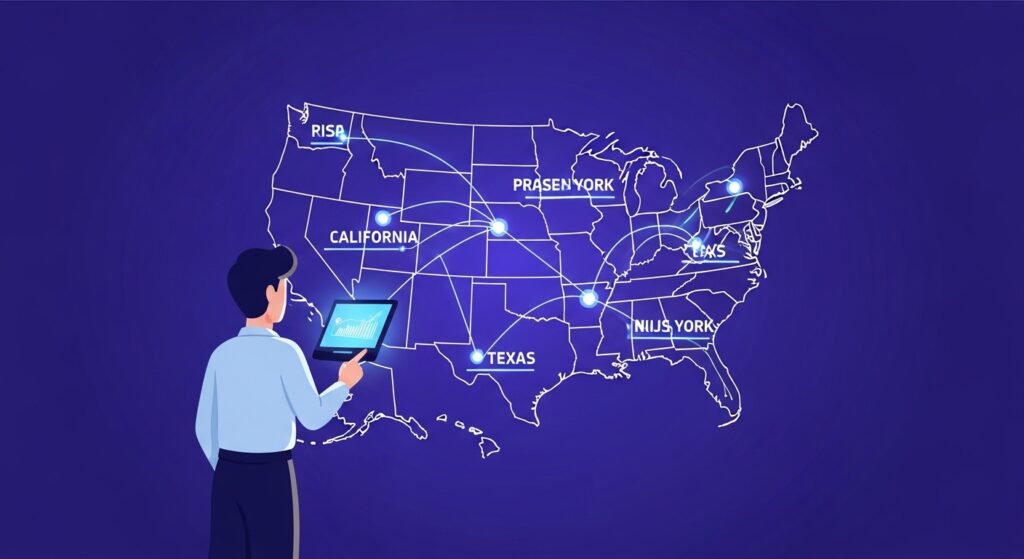
Geographic Distribution of Foreign Labor Certification
The Office of Foreign Labor Certification (OFLC), a division of the DOL, systematically tracks the geographic destination of sponsored foreign workers through the Labor Condition Application (LCA) and Permanent Labor Certification (PERM) processes. The resulting datasets demonstrate that demand is not distributed uniformly nationwide. Instead, it is highly centralized in states maintaining major metropolitan economic hubs or extensive agricultural infrastructures. Employers in these states actively utilize the federal immigration framework to fill structural vacancies that cannot be mitigated by the domestic workforce.
1. California: Technology and Agricultural Sectors
California consistently registers the highest absolute volume of both non-immigrant and immigrant labor certifications, driven by two divergent but highly active economic sectors.
Silicon Valley and H-1B Concentrations
The San Francisco Bay Area and Silicon Valley represent the primary destinations for H-1B specialty occupation workers. Major technology conglomerates and software engineering firms file tens of thousands of initial and extension petitions annually. The demand is heavily concentrated in occupations categorized under the North American Industry Classification System (NAICS) code 5415 (Computer Systems Design and Related Services). Roles such as artificial intelligence architects, data scientists, and cloud infrastructure engineers constitute the bulk of these filings. Compensation metrics in this region consistently exceed national averages, obligating employers to meet high prevailing wage standards established by the National Prevailing Wage Center (NPWC).
Central Valley and H-2A Certifications
Simultaneously, California's agricultural sector relies heavily on the H-2A temporary agricultural worker program. The state's Central Valley requires significant seasonal labor for crop harvesting and cultivation. Growers and agricultural associations submit applications demonstrating that a shortage of domestic workers necessitates the importation of seasonal foreign labor. The DOL mandates strict compliance regarding housing, transportation, and adherence to the Adverse Effect Wage Rate (AEWR) for all H-2A workers stationed in California.

2. Texas: Energy, Engineering, and Healthcare
Texas has established itself as the second-largest sponsor of foreign talent, characterized by rapid corporate relocation and expansive infrastructure development.
The Energy Corridor and Specialized Visas
Houston's Energy Corridor is a global hub for petroleum, natural gas, and rapidly expanding renewable energy initiatives. Engineering firms operating within these sectors actively sponsor foreign nationals for H-1B, L-1 (intracompany transferee), and TN (United States-Mexico-Canada Agreement) visas. The Department of Energy (DOE) frequently highlights the critical need for structural, petroleum, and grid modernization engineers. Multinational energy corporations utilize the L-1B specialized knowledge and L-1A executive visas to seamlessly transfer critical personnel from international subsidiaries to their Texas-based headquarters, facilitating large-scale infrastructure projects.
Urban Medical Centers and H-1B/J-1 Physicians
Furthermore, the Texas Medical Center in Houston, alongside expanding healthcare networks in Dallas and Austin, generates substantial demand for foreign-trained medical professionals. Due to designated Health Professional Shortage Areas (HPSAs) across the state's vast rural and semi-urban counties, medical facilities aggressively sponsor J-1 exchange visitor physicians and subsequently support Conrad 30 waivers to transition these professionals into H-1B status. Permanent labor certifications (PERM) for registered nurses and specialized physical therapists also qualify for expedited permanent residency processing under the DOL's Schedule A designation, bypassing the standard PERM labor certification delays.
3. New York: Financial Services and Academic Research
New York commands a massive share of employment-based visa sponsorships, segmented primarily into the global financial sector and high-level academic research. The concentration of capital and intellectual property in this region creates a hyper-competitive landscape for international recruitment.
Quantitative Analysis and Financial Technology
Institutions headquartered in Manhattan's financial district are among the most aggressive sponsors of foreign talent. Demand is highly focused on quantitative analysts, algorithmic traders, and financial risk managers. Employers typically utilize the H-1B program, alongside the E-3 visa for Australian professionals and the H-1B1 for eligible nationals from Chile and Singapore. Data from the Securities and Exchange Commission (SEC) and prevailing wage determinations indicate that compensation in this sector frequently exceeds $200,000 annually.
To secure talent rapidly, financial conglomerates also sponsor O-1 visas for individuals demonstrating extraordinary ability in mathematical modeling or financial engineering. Furthermore, financial firms initiate thousands of PERM applications annually to transition these highly specialized employees into permanent residents, solidifying their long-term operational infrastructure.
Academic and Scientific Research
New York also houses a dense concentration of research universities and medical institutes. These entities benefit from being cap-exempt employers, allowing them to file H-1B petitions year-round without being subjected to the annual statutory lottery managed by USCIS. Furthermore, these institutions are the primary sponsors of J-1 exchange visitors for postdoctoral fellowships and scientific research positions. This institutional framework ensures a continuous pipeline of global scientific talent directly into the state's research ecosystem.

4. Washington: Cloud Computing and E-Commerce Infrastructure
The state of Washington, specifically the greater Seattle metropolitan area, represents a critical node for international tech recruitment. The region's economy is heavily anchored by global leaders in cloud computing, enterprise software, and e-commerce logistics, generating sustained, high-volume visa sponsorship activity.
Software Engineering and L-1 Intracompany Transfers
While Washington employers utilize the H-1B program extensively, there is a pronounced reliance on the L-1 visa category. Multinational corporations use the L-1A (for managers and executives) and L-1B (for specialized knowledge workers) to relocate essential personnel from development centers in India, Canada, and Europe directly to their Washington headquarters. This strategy provides operational continuity for complex, multi-year software development cycles and infrastructure deployments.
Prevailing wage data from the OFLC confirms that base salaries for cloud architects and senior developers in this region average between $140,000 and $180,000. Employers must meticulously document that these compensation packages meet or exceed the local prevailing wage to maintain their standing with federal immigration authorities and prevent labor market displacement.
5. Florida: Hospitality, Construction, and Healthcare Expansion
Florida’s demographic shifts and sustained population growth have generated unique structural labor shortages, driving high volumes of visa sponsorships across non-technical and service-oriented sectors.
The H-2B Non-Agricultural Program
Florida's vast tourism and hospitality industry relies critically on the H-2B temporary non-agricultural worker visa. Resorts, amusement parks, and commercial landscaping companies file extensive labor certifications to secure seasonal staff. Due to the statutory annual cap of 66,000 H-2B visas nationwide, Florida employers frequently petition the Department of Homeland Security (DHS) and the DOL for supplemental visa allocations authorized by Congress to prevent operational disruptions during peak winter tourist seasons.
Structural Engineering and Medical Demand
Simultaneously, massive real estate development and infrastructure projects necessitate the sponsorship of civil, civil, and structural engineers. Florida employers often utilize the TN visa for qualified Canadian and Mexican engineering professionals to expedite project timelines.
Additionally, Florida's rapidly aging demographic has intensified the state's clinical nursing shortage. Medical facilities and hospital networks actively sponsor foreign-trained registered nurses through the EB-3 immigrant visa category, leveraging the expedited Schedule A process to build a permanent, long-term healthcare workforce.

Regional Compliance and Enforcement Protocols
Employers sponsoring foreign workers in these high-demand states are subject to rigorous oversight by federal regulatory agencies to ensure the absolute protection of the domestic labor market and adherence to immigration statutes.
Site Visits and Wage Audits
The Fraud Detection and National Security Directorate (FDNS) conducts unannounced administrative site visits concentrated heavily in high-volume states like California, Texas, New York, Washington, and Florida. These physical inspections verify that the sponsored employee is actually working at the location specified in the petition, performing the exact duties outlined in the occupational classification, and utilizing the equipment required for the role.
Furthermore, the Wage and Hour Division (WHD) actively audits employers to confirm that the actual wages paid align perfectly with the regional prevailing wage rates stipulated on the certified labor condition applications. Employers are legally mandated to maintain a Public Access File (PAF) for every H-1B worker, containing detailed payroll records, wage rate determinations, and benefits summaries. Discrepancies found during these audits or site visits result in severe penalties, including substantial financial fines, mandatory back-pay to employees, and potential multi-year debarment from participating in any federal immigration sponsorship programs.
Read more about: [U.S. Permanent Resident Visa Categories for Multinational Managers]
Disclaimer: This guide is for informational purposes only and is based on public data available for 2026. Visandwork.com is not a government agency, does not issue visas, and does not provide personalized legal or immigration advice. Always consult official government portals before initiating any application process.