Navigating the Canadian Work Visa Process: Common Application Errors
The Canadian immigration framework, administered by Immigration, Refugees and Citizenship Canada (IRCC) and Employment and Social Development Canada (ESDC), is a highly regulated statutory system. Securing a temporary work permit requires strict adherence to legislative procedures and documentary standards. Due to the high volume of applications processed annually, adjudicating officers have limited discretion to request missing information. Consequently, procedural errors, omitted documentation, and substantive discrepancies frequently result in immediate application refusals, extended processing delays, and, in cases of misrepresentation, multi-year bans from entering Canada. This document details the most prevalent administrative and evidentiary errors committed by employers and foreign nationals during the Canadian work visa application lifecycle.

Foundational Errors in Employer Sponsorship (LMIA)
For the majority of temporary foreign workers, the application process relies on the employer successfully securing a Labour Market Impact Assessment (LMIA). This preliminary stage falls under the jurisdiction of ESDC, and errors here invalidate any subsequent work permit applications.
Inadequate Domestic Recruitment Efforts
Before applying for an LMIA, Canadian employers must legally demonstrate that no Canadian citizen or permanent resident is available, qualified, and willing to fill the position. A primary cause for LMIA refusal is failing to meet ESDC's strict advertising requirements. Employers must post the vacancy on the federal Job Bank and at least two other commercial or specialized recruitment platforms. Errors include running the advertisements for less than the mandated continuous four-week period, failing to target underrepresented employment groups, or omitting mandatory information such as the business address, the exact prevailing wage, and the corresponding National Occupational Classification (NOC) code.
Misclassification of the National Occupational Classification (NOC)
The entire Canadian economic immigration system is indexed by the National Occupational Classification (NOC). A critical and frequent error is selecting an incorrect NOC code or Training, Education, Experience and Responsibilities (TEER) category for the intended position.
Employers and applicants often match the corporate job title to the NOC registry rather than matching the actual daily duties. If an employer applies for a TEER 0 (Management) LMIA to circumvent wage thresholds or expedite processing, but the detailed job description aligns with a TEER 2 (Supervisory or Administrative) role, ESDC will refuse the application for misclassification. Furthermore, the assigned NOC code strictly dictates the prevailing wage that must be paid. Failing to guarantee the median wage listed for that specific NOC in the targeted economic region is an immediate violation of the Temporary Foreign Worker Program (TFWP) regulations.

Deficiencies in the Foreign Worker's Application
Once a positive LMIA is issued, or if the applicant qualifies for an LMIA-exempt pathway under the International Mobility Program (IMP), the foreign national must submit the formal work permit application to IRCC. Evidentiary deficiencies at this stage represent the highest volume of refusals.
Insufficient Proof of Work Experience
IRCC requires definitive proof that the foreign worker possesses the exact qualifications, educational background, and employment experience required for the designated NOC code. The standard employment reference letter is the primary mechanism for this verification. Applicants frequently submit generic letters from former employers that only state the dates of employment and the job title.
To satisfy IRCC statutory requirements, an employment reference letter must be printed on official company letterhead, signed by the responsible supervisor or human resources officer, and include the company's full contact information. Crucially, the letter must explicitly detail the specific daily duties performed, the number of hours worked per week, and the annual salary plus benefits. If the detailed duties do not correspond comprehensively with the lead statement and main duties of the claimed NOC code, the IRCC adjudicating officer will conclude that the applicant lacks the required experience and legally refuse the application.
Omission of Mandatory Police Clearances
Under the Immigration and Refugee Protection Act (IRPA), all foreign nationals seeking entry must be admissible to Canada. Criminal inadmissibility is a strict barrier. A systemic error in the application process is the failure to submit required police certificates. IRCC mandates that applicants provide a valid police certificate from every country, including their country of citizenship, where they have resided for six consecutive months or longer since reaching the age of 18. Applicants often mistakenly assume that a background check from their current country of residence is sufficient. Delays in requesting these international documents frequently cause the application to exceed the allocated submission timeframe, resulting in administrative closure. Furthermore, failing to disclose past arrests, even if they resulted in acquittals or expunged records, constitutes material misrepresentation. The criminal rehabilitation process, which may allow individuals with prior convictions to legally enter Canada, requires a separate, complex application process that must be entirely resolved before submitting any work permit documentation.
Improper Medical Examinations
For specific occupations—particularly within healthcare, primary agriculture, food processing, and childcare—an Immigration Medical Exam (IME) is a strict statutory requirement. A pervasive error is submitting medical records from a personal, local physician rather than an IRCC-approved Panel Physician. Additionally, applicants frequently fail to recognize that an IME is only valid for 12 months. Submitting an expired IME or failing to undergo an upfront medical exam when the specific NOC code dictates it will trigger immediate processing delays or outright application refusals based on public health inadmissibility.

Port of Entry (POE) Misunderstandings
The approval of a work permit application by IRCC does not result in the physical work permit being mailed to the applicant's foreign residence. This administrative distinction generates significant confusion and critical errors at the border.
The POE Letter of Introduction
Upon application approval, IRCC issues a Port of Entry (POE) Letter of Introduction via the applicant's secure online portal. A critical error occurs when foreign nationals arrive at a Canadian border crossing assuming this letter is their actual work permit. It is not. The Canada Border Services Agency (CBSA) officer retains the absolute statutory authority to issue the physical work permit document, and they do so only upon conducting a final admissibility inspection at the border.
Missing Physical Documentation
Foreign workers frequently arrive at the POE without physical copies of their application materials. The CBSA officer will mandatorily require the applicant to present a valid passport, the POE Letter, the physical positive LMIA annex (if applying under the TFWP), and the signed employment contract. Relying on digital copies stored on mobile devices is highly discouraged, as secondary inspection areas often restrict or prohibit mobile phone usage. Failure to produce the required physical documents upon demand can result in the CBSA officer denying entry, issuing a removal order, and cancelling the approved visa.
Maintaining Legal Status and Compliance Errors
Once a foreign national is inside Canada, the regulatory burden shifts entirely to maintaining legal status. The strict conditions printed on the physical work permit document are legally binding.
Unauthorized Employment on Closed Permits
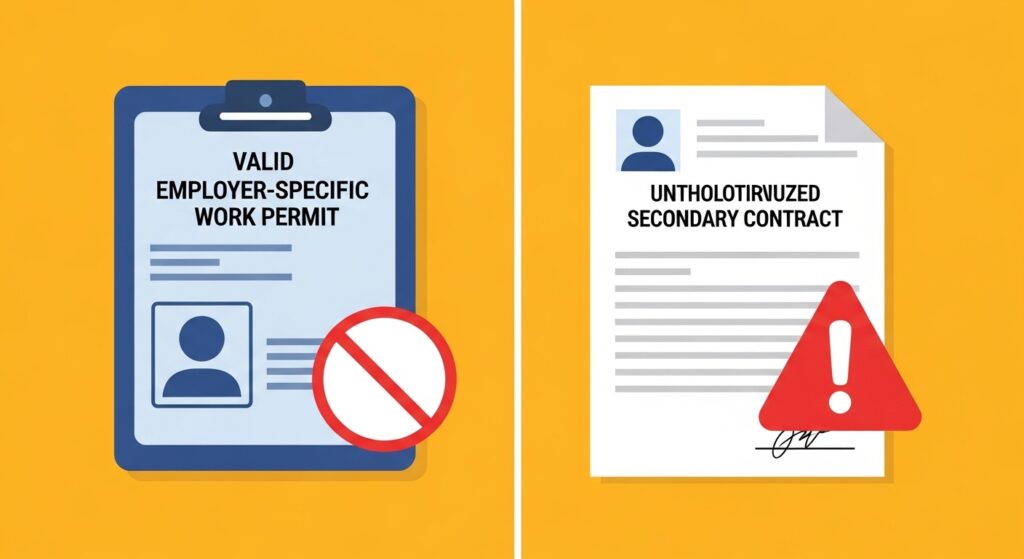
The vast majority of work permits issued under the TFWP are employer-specific (closed) permits. A pervasive and severe compliance error is a foreign national accepting secondary employment, or transferring to a different branch, subsidiary, or franchise of the same company without prior IRCC authorization. Working for any employer other than the one explicitly named on the work permit, or working in a different geographic location or NOC code than specified, constitutes unauthorized employment. This violation renders the worker out of status, subject to immediate deportation, and structurally compromises any future permanent residency applications under the Canadian Experience Class (CEC).
Failing to Maintain Implied Status
When a foreign worker seeks to extend their stay in Canada, they must submit their renewal application prior to the expiration date of their current work permit. Submitting the application before this expiration grants the applicant "maintained status" (formerly known as implied status), allowing them to continue working under the exact same conditions while awaiting IRCC's decision.
A common error is missing this critical filing deadline. If a work permit expires before an extension is officially filed, the foreign national must immediately cease all employment activities. They then face a strict 90-day window to apply for a Restoration of Status. This restoration process incurs significant additional government fees and explicitly requires the individual to remain unemployed throughout the entire processing period, causing severe financial disruption.
Fraud and Material Misrepresentation
The most catastrophic error in the Canadian immigration process is engaging in fraud or misrepresentation. Section 40 of the Immigration and Refugee Protection Act (IRPA) defines misrepresentation broadly, encompassing both direct falsehoods and the withholding of material facts.
Consequences of Section 40 Violations
Misrepresentation includes, but is not limited to:
- Submitting forged educational degrees or altered credential assessments.
- Fabricating past employment history or inflating the complexity of duties to match a higher NOC code.
- Failing to declare previous visa refusals from Canada, the United States, the United Kingdom, or any other nation.
- Utilizing unregistered "ghost consultants" to prepare applications without declaring their assistance on the official representative forms.
IRCC utilizes sophisticated global database sharing, including biometrics data exchange with the Five Eyes intelligence alliance, to verify applicant data and uncover historical inconsistencies. If an adjudicating officer determines that material misrepresentation has occurred, the application is denied, and the applicant is issued a mandatory five-year ban from entering Canada. During this five-year inadmissibility period, the foreign national is legally barred from applying for any temporary or permanent Canadian visa. Both employers and foreign nationals must exercise absolute transparency and rigorous administrative oversight throughout the entire application lifecycle to ensure statutory compliance and successful visa issuance.
Read more about: [Canadian Express Entry and the Comprehensive Ranking System (CRS)]
Disclaimer: This guide is for informational purposes only and is based on public data available for 2026. Visandwork.com is not a government agency, does not issue visas, and does not provide personalized legal or immigration advice. Always consult official government portals before initiating any application process.